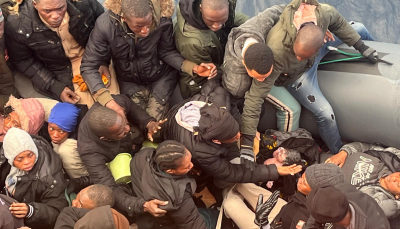
On the Epiphany, the crew of the Guardamar Talía returned to Lanzarote with a smile: after a week of rescues almost without a break, many more than 100 kilometers from their base in Arrecife, that day's service gave all eight of them the experience of successfully assisting a baby who had just been born at sea in an inflatable boat with 64 people on board.
For almost everyone in Talía it was a new experience. Not for the boat's skipper, Domingo Trujillo, a veteran of Maritime Rescue in the Canary Islands who has already attended three births. "This time I didn't have to cut the cord, not like the last time," he jokes, referring to the baby he rescued in 2020 in Fuerteventura, with the Salvamar Mízar.
However, a situation like that is always overwhelming, even for someone like him, with 23 years of service in Salvamento, he confesses in an interview with EFE. Trujillo still has the memory fresh: the baby stood out in the middle of the inflatable boat, naked, surrounded in silence by the rest of his traveling companions. He had been born no more than 15 minutes before.
It is the scene that is already going around Spain this Wednesday thanks to a photo taken by one of the sailors of the Talía.
Question.- The Salvamento crews in the Canary Islands have been having hectic days, with several daily rescues, especially in Lanzarote and El Hiero. How was that one in particular?
Answer.- The Las Palmas Salvamento Coordination Center activated us at 4:00 in the morning, I think I remember, and already informed us that there was a pregnant woman in an advanced state of gestation in the inflatable boat, who could give birth at any moment. We left already prepared and reviewing what we would have to do if that were the case. We arrived to them at about 9 in the morning. They were 97 miles (180 km) from Arrecife, it took us five hours to get there.
Q.- One of your colleagues took a photo with the mother and the baby in the bow and the rest of the immigrants surrounding her. How do you remember the scene you found when you arrived?
A.- Well, we already knew what could be there, but the surprise was confirming that the baby was there. He stood out because he was completely naked, without clothes, without anything to cover him, which gave us to understand that the birth had occurred perhaps 10 or 15 minutes before our arrival. We proceeded as always, with the exception that there was a woman and a newborn in those conditions, so we took the rest of the people out first, because the weather conditions were good and they were all calm. The woman and the baby were the last to leave. Two colleagues got on the inflatable boat to help them, and we installed them in the Guardamar's infirmary.
The girl was in the bow of the inflatable boat. It seems that they (the other migrants) had put her there so that she could give birth a little more comfortably. There were 64 people in nine meters of boat. Let's say they were squeezed, but there was some slack around her.
The baby was crying, which indicated that he was alive and there were no problems, and we asked the woman for permission to undress her, clean her and groom her with all due respect. We put the baby with her, who already had the umbilical cord, it was cut by some of her traveling companions. All we did was hold the child, give it to the mother and wrap them up for the trip (on the way back, a helicopter evacuated both to the hospital in Lanzarote).
Q.- You already have experience in these situations, had any of your Talía colleagues also rescued a baby born in a boat?
A.- None of them had experienced that situation. Some had had some threats, but none had been in this situation of having to pick up a newborn. For me it was also a surprise, because of the image of the naked child, seeing him like that, just after the birth.
Q.- Do you remember it differently? For you it was already the third baby born at sea that you have rescued.
A.- The difference is that this time the umbilical cord was already cut, I didn't have to do it. In a way that relieved me. Although it is still beautiful and an unforgettable experience, cutting it requires having a little courage, not for the mere fact of cutting it, but for the fear of not doing it well. For me, the three cases that I have had to attend to of these characteristics are all particular. All rescues have their moments, even the negative experiences, when you have to face unpleasant things.
Q.- Has experiencing a birth with a happy ending on Epiphany had any impact on your crew, after such hard days, in which they have hardly stopped going out to sea, rescue after rescue?
A.- The truth is that we have a good streak (he jokes) and in a way we are exhausted. Almost every night leaving at dawn, arriving late... You arrive, dock and start tidying up the boat and preparing it for the next departure. It is getting a bit tense, but the satisfaction remains. Some will express it; others, not, but it remains. This case is very positive, because it was with a newborn, but in all the services we do, even if we are tired, we know that we help people in trouble.
Q.- Have you been able to find out anything about the mother and the child?
A.- I asked yesterday and the tower (the Salvamento control in Las Palmas) told me that they were fine, in the hospital. And here I am, wondering whether to call the Red Cross to try to get some of us to visit her. I, at least, would like to see her. EFE
"The baby stood out in the middle of everyone: he was naked, he had been born just 10 minutes before"
Domingo Trujillo, captain of Maritime Rescue, was one of those in charge of rescuing 64 migrants who were traveling in a precarious boat with the newborn near the coasts of Lanzarote
January 8 2025 (14:13 WET)
Updated in
January 8 2025 (14:21 WET)