
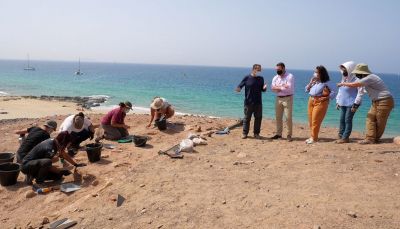
The archaeological research project in San Marcial de Rubicón, in Playa Blanca, has started a second phase within the new agreement signed between the Government of the Canary Islands, the Yaiza City Council and the public universities of La Laguna and Las Palmas de Gran Canaria. The first results have revealed "masonry structures with occupation levels associated with 15th century landfills, with aboriginal and colonial ceramics appearing, as well as consumption remains," as indicated by archaeologist Miguel Ángel Hervás and the co-director of the research, Esther Chávez. This campaign, developed in the first permanent European settlement in the Canary Islands, "aims to advance in the different archaeological units through soundings, excavations and, above all, geophysical surveys, both terrestrial and marine, to locate possible buried structures."
The results of the first days of archaeological work in San Marcial del Rubicón have yielded, according to the organizations, good results, selecting three points of interest. The first, where a worked rock was observed from which "masonry structures with occupation levels associated with 15th century landfills, with aboriginal and colonial ceramics appearing, as well as consumption remains," indicate archaeologist Miguel Ángel Hervás and the co-director of the research, Esther Chávez. The second area intervened, "is where in the 80s some structures had already been identified by professors Tejera Gaspar and Aznar Vallejo and, in effect, a room with an occupation level and several associated hearths has appeared along with materials typical of the 15th century," they add. Finally, they explain that there was evidence provided by the ground-penetrating radar, in the area of greatest strategic value for the defense of the place, "which has allowed us to verify a section of wall structure almost two meters thick, associated with what the written sources call the Castillo del Rubicón, being one of the great discoveries of the campaign."
The general director of Cultural Heritage, Nona Perera, emphasizes that this action is "comprehensive and multidisciplinary by using both documentary sources and current research techniques that lead us to increase the knowledge of what happened here, beyond the founding of the city in 1408, but from the first human settlement." The head of the Heritage area of the Government also highlighted that "there is a team of 15 people, including students from the two Canarian universities, taking advantage of this intervention for their training. Likewise, she stated that "the installation of provisional information panels and the redirection of trails to avoid possible losses or alterations in the state of conservation of the visible structures is planned."
For his part, the mayor of the municipality of Yaiza, Óscar Noda, declared "the commitment of his corporation to the investigation of this archaeological zone, because we are treading on the history, not only of Yaiza but of the Canary Islands." He also pointed out "the importance of dissemination to convey the value of its protection, for which guided tours will be organized in the future."
In the area there are "other social formations typical of the ancient inhabitants of the island"
From the Government they point out that the San Marcial de Rubicón site, "is an archaeological enclave of high scientific and patrimonial level since it shows the first contacts between European and aboriginal culture in the 15th century". From this area "the process of exploration and conquest of the Canary archipelago begins, which led to the construction of architectural elements that have been discovered in recent decades such as a tower-fortress, a church, some wells, as well as other structures related to the settlement." In addition, in this nucleus there are also "other social formations typical of the ancient inhabitants of the island, such as a necropolis."
The global purpose of this project "is to advance in the knowledge of this outstanding site, promoting its research, conservation and protection of its heritage, as well as its dissemination and enhancement." Among the lines of action of this new campaign, they point out that archaeological works are being carried out such as "surface and geophysical surveys, soundings and excavations in extension and geophysical and underwater prospecting of the coastal area of the site". To these main actions will be added the interventions that derive from them, such as restoration and consolidation of the exhumed units that require it, as well as the study of the resulting archaeological materials.
New methodologies
From the Government of the Canary Islands they also maintain that through the methodology of surface prospecting, geophysical prospecting and stratigraphic excavation "the limits of the archaeological zone will be clearly defined and possible structures within it will be recognized, as well as recording the archaeological materials located at surface level in the corresponding files."
Terrestrial geophysical prospecting is used "to detect buried structures with non-destructive methods, since it ensures an investigation depth of approximately two meters on the archaeological area". Complementary to this action, it is proposed to carry out a prospecting by means of electrical tomography (ERT) in order to support the interpretation of the results obtained by means of the ground-penetrating radar to obtain information on the geoarchaeological context to a depth of approximately 6 meters.
Regarding underwater prospecting, a pioneering method in this site, they note that "it allows to make a sounding on the coast by means of a suction sleeve with the removal of the stratigraphic deposit and find out if there is presence of material remains in the sedimentary package. In principle, the extraction of material from the marine environment is not contemplated, only those objects that have a high risk of deterioration or disappearance


