
All Saints' Day is celebrated throughout Spain today. Tomorrow, Wednesday, on the other hand, the Day of the Dead is commemorated according to the religious calendar, a date on which the dead must be honored and remembered by the living. Tradition dictates that it be tomorrow when family and friends visit their deceased loved ones. However, the custom of Spaniards is to go to cemeteries on November 1, All Saints' Day in the Catholic calendar.
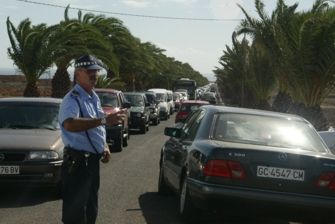
The cemeteries throughout the country and throughout the Canary Islands, without exception the Island of Volcanoes, were overflowing with people yesterday, faithful followers of the traditions who have not hesitated to approach the graves of their dead.
Flowers to the tombs
Hundreds and hundreds of people, thousands throughout Lanzarote, have brought bouquets of flowers to the tombs of cemeteries throughout the Island today. An atmosphere of serene and sad bustle overwhelmed the cemeteries of Lanzarote yesterday. Roses, carnations, lilies and gladioli, among many other flowers, flood the place of eternal rest for thousands of people.
The Spanish, truth be told, are not at all fond of visiting cemeteries very often. Death, in a predominantly leisure culture, does not have for the inhabitants of this country a meaning and a transcendence as deeply rooted and followed as in other parts of the Christian world, as it could be in the Orthodox culture. And that is precisely why a day like yesterday is so important for the population, especially believers, who pour all their emotions regarding the deceased into a single day a year.
A tribute to the ancestors
The visit to the cemeteries takes place on November 1 and 2. It is a rite of remembrance and tribute to the ancestors. In all the churches, masses are offered in memory of these loved ones that serve to shorten the supposed years of purgatory in the afterlife. The stay of the relatives in the cemetery will be longer if the death has occurred recently. In any case, it cannot be said that it is a generalized habit, since the population that visits the cemeteries is usually the oldest.
Many Spaniards feel a deep aversion to any situation related to death and choose to ignore it, perhaps with the hope that this attitude will keep it away from their lives. In any case, the visiting relatives light candles throughout the night and the cemetery remains open. No tomb is left without light and flowers.
Religious celebrations
In Spain, a large part of our traditions are at the same time religious traditions and our holidays are mostly religious festive celebrations. The reason for all this is that Catholicism has become culture in our society and as it is part of our culture, of our traditions, all citizens prepare to celebrate these popular religious celebrations.
Due to the cultural nature, popular religious behaviors are transmitted from one generation to another, therefore those who have been born in the society that celebrates them, feel and live these traditions as something of their own, something that belongs to them, whether they are believers or not.
A huge public square
In urban societies, religion is not an element of social cohesion, because they are societies that have reached a high degree of experimentation and religion ceases to be the only theoretical resource explaining reality. Nor does the festive dimension enjoy the functions it has in rural societies. They are programmed and controlled parties and have a new function which is to free from the routine of work.
The cemetery, in these first two days of the month of November, is the immense public square where the most unusual manifestations and the strangest encounters between the living and the dead appear. The bustle of the big cities contrasts with the rural cemeteries that become a place of multiple reunions. On this day the maxim of popular feeling is expressed "it is better to get along with the dead".


