
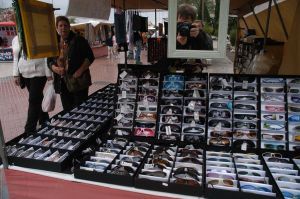
It is mid-morning and although wallets, in theory, are empty after the squandering on behalf of Santa Claus and the Three Wise Men, Calle Real and the market that usually sows the Ramírez Cerdá park with stalls is overflowing. Tourists strolling, retirees and housewives with shopping carts prowling the stalls in search of a bargain that allows them to save a few euros in days of inflation. And among singing shopkeepers offering their rags at single-digit prices and some other stall that still sports Christmas tablecloths, there they are: wallets, bags, belts, sunglasses and watches. All from brands that are advertised with glamor in good paper magazines and all at almost bargain prices.
"That cap you have in your hand I sell it for 15 euros." The shopkeeper strives to make his Spanish understandable next to a table full of caps stamped with the superimposed initials of LV (Louis Vuitton), next to a string of belts from the Hugo Boss firm. After assuring several times that it was an original cap, despite not having a single label to prove it and that inside you could read Made in China, the shopkeeper offers it, along with a belt, for five euros. If Vuitton raised his head?
In another stall in the Ramírez Cerdá park they offer a Prada bag, which they advertise as genuine leather, for 40 euros. The seller swears it is authentic, as are the bags and wallets of the well-known Catalan brand Tous, which he offers for 40 and 20 euros respectively, prices always subject to reduction.
Thus, up to a dozen stalls in which the fake Gucci, Prada, Burberrys and Armani are displayed on outdoor boards waiting for the buyer eager to wear the expensive initials knowing that they are fake or the naive person who will fall into their error when proudly showing the purchase to someone more savvy.
Police action
And all this a few meters from the Arrecife Municipal Police. And it is that, as José Antonio Lasso, head of the Municipal Police of the capital, explains, their functions in the fight against piracy are limited, being limited to reporting the sale of counterfeits, if they are detected, to the National Police Corps, so that they can determine if they are indeed fraudulent products.
"On other occasions we act together with consumer inspectors," explains Lasso, "if we suspect that the products being sold are fake and the specialized unit of the National Police so determines and lifts the merchandise, then we collaborate." But the Local Police normally acts in the market when a stall does not have municipal permission to sell on the street and, usually, if there is a prior complaint.
For its part, when the National Police is on patrol with a bazaar or a market in which a stall sells counterfeit products, it does not always intervene, unless there is a complaint about this practice. "Normally, if there is no complaint, nothing is done, although ex officio, it can be intervened if they are obviously false," explains the chief commissioner of the National Police, José Antonio Fernández García Camacho, "the one who sells in the stall usually has little merchandise and what is really interesting is the warehouse that distributes it. If the one in the stall speaks, we can pull from there to catch the distributor."
"Sometimes the Police forgive us," says a seller of fake Burberrys wallets in the Ramírez Cerdá park, "I have little things and I don't deceive the buyer, I say they are fake." On occasions when the National Police acts, the merchandise is seized and the data of the person selling it is taken or they are arrested, "depending on the amount," the commissioner points out. The Court takes charge of the complaint and a representative of the injured brand is summoned to appear as an accusation.
But according to sources from the Civil Guard Headquarters, when they act ex officio, that is, without a complaint from the brand in between, in many cases no representative of the pirated commercial house appears, so most of the judges, file the complaints.
The Civil Guard in Lanzarote has acted during the year 2007 on 47 occasions. The most important of the year took place last May when the troops of the Territorial Fiscal Patrol of the Benemérita of Costa Teguise seized 800 articles in Puerto del Carmen that falsified the Louis Vuitton signature, valued at half a million euros.
Puerto del Carmen and counterfeits
And it is that the sale of counterfeits is not only a matter of markets. The tourist town of Tías, in which bazaars abound like mushrooms, is a recital of Gucci "tin" bags, second-hand Calvin Klein underwear and Adidas caps that are almost scary, how similar they are to the authentic ones, although their modest price returns them to reality. In one of the numerous bazaars that crowd the Avenida de las Playas, products at one euro are mixed with caps of different brands at a good price. Are they real? The shop assistant expresses with gestures that she does not understand the question and her partner comes to the rescue, who after hesitating recognizes that "they are imitations."
In an electronics bazaar on the same street, they offer a digital camera, they assure that it is from the Sony brand, with great capacity and quality for the modest price of 80 euros, less than half its price on the internet, but according to the person in charge of the store, he sells it "without its box", due to a "recent store transfer that has lost some wrappers".
In a nearby store, dozens of reproductions of Gucci and Prada bag models are displayed on the shelves with signs on fluorescent paper, typical for offers, on which the price is read: 14.95 euros.
The same reproduction of the Prada bag ends up being offered by the shopkeeper of one of the stalls in the Ramírez Cerdá park for what the doubtful buyer has loose in his pocket. "Ten euros and you take the bag," after admitting that he had lied, that it was not true. "Nothing that is sold here is true," he confesses.
The real bag at 300 euros and the fake one at 50
The sale of counterfeits affects and whoever says otherwise is lying." The speaker is Teresa Curbelo, president of the Arrecife Zona Centro merchants association, who understands that the price difference between an authentic and a fake item "is incredible" and recognizes that "the bag you buy in the market is not going to be bought from you."
During the past Christmas, the merchants association has seen how the counterfeiting of a bag from a well-known firm was sold in the Arrecife market for 50 euros and in a store in the central area the same model cost, yes, from the firm in question, 298 euros. "It was an exact reproduction, even the bag in which it is packaged was falsified," says Teresa Curbelo.
But some of the market vendors do not feel that they are harming commercial houses. Surrounded by cosmetic products, reproductions of Armani sunglasses and some pirated Burberrys wallets, the person in charge of one of the stalls assures that whoever wants to buy the real one does not approach her stall. "I sell them for 10 euros and in the store it costs 100, whoever wants a wallet of that price, goes to the store, I am not competition for them," she explains calmly. She is not afraid of police actions against piracy, nor that she may be charged with a crime against industrial property. "What is the police going to do to me, if I sell reproductions."
Teresa Curbelo recognizes that there is concern about this issue in the association, although they have not reported it to the police. They consider that "it is a difficult fight because when they intercept a shipment of bags, another one arrives immediately." But they have reported the sale of counterfeits directly to the affected commercial houses, inviting some of their representatives to check in situ where their pirated products are sold.
From passing off a cat for a hare to psychological moonshine
The trade in alcoholic beverages and tobacco is not free from fraudulent activities. From the Association of Businessmen of Tías and Puerto del Carmen they point out that in the tourist town "some businesses operate with the smuggling of these products." "If the tobacco distributor sells you a carton for 18.30 euros and the business next door sells it to the public for 18.35, it is clear that with those five cents they do not pay rent, employees and obtain profit. They buy the merchandise cheaper," they explain in the association.
A practice that is repeated with alcohol and that forces distributors to take action on the matter. Diageo distributes different alcoholic beverages, mainly well-known brands of whiskey, and although it has a department that fights against counterfeiting, the company confirms that they have detected on some occasion the entry into Spain of its products from Asia, skipping European controls and the payment of fees and tariffs. "Although the product is ours if it enters skipping community tariffs, it attacks national interests and against the company in Spain, it infringes the trademark law." When they detect these practices, the firm reports it to the Police.
But in addition, alcoholic beverage distributors and consumers who suffer its effects face the practice of refilling: the quality whiskey for which the consumer pays has been previously replaced by another worse one. Diageo sources assure that it does not happen as often as you think and the dreaded hangovers are rather the result of what they call "psychological moonshine", that is, having mixed various drinks or having had too many drinks, although the subsequent discomfort is always attributed "to the moonshine they put in the last drink."
Diageo has representatives of its distributor who anonymously appear in entertainment venues, order whiskeys of its brand and with a meter that, according to the distributor, records "all the organoelectric coordinates and characteristics of the house product", they check if the drink they have been served is the good one. "We detect in 3% or 4% of the occasions that it is not our whiskey," point out sources from Diageo in Spain, who in those cases report the falsification so that measures are taken against the premises.


