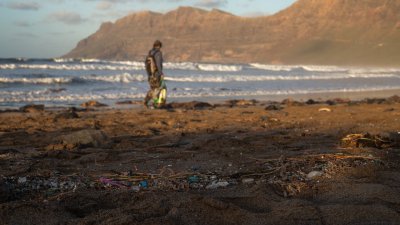
A Canarian investigation warns of the deficiencies when it comes to scientifically assessing the real impact of microplastics in the sea and warns of the lack of studies on the affection in deep oceans and complete water columns. This is stated in an article published in Environmental Research.
Researchers from the Universidad de La Laguna, from the Universidad de Las Palmas de Gran Canaria and from the Instituto Español de Oceanografía, dependent on the Centro Oceanográfico de Canarias, have analyzed 40,000 articles published in the last four decades to reach this conclusion.
In the report, they have highlighted that although the ocean depths represent the greater part of the marine volume and that they accumulate, in the long term, the microplastics that are being lost in the sea, they are "underrepresented" in scientific research.
In this way, the researchers point out the lack of sampling below a thousand meters of depth, compared to the varied research on the impacts of microplastics on beaches, due to their impact on coastal ecosystems and local communities.
In this regard, they have highlighted that the amount of microplastics that ends up contaminating the planet's marine depths has not been fully quantified, despite the fact that it is known that these act as "final sinks". Despite this, there are previous studies that show the presence of microplastics in the water columns of the Atlantic at 1,150 meters.
The researchers attribute this lack of representation to the difficulties professionals face when taking samples at great depth due to the "remoteness and logistical complexity".
Finally, the research advises the expansion of scientific work to cover "the depth and breadth of the ocean", so that mitigation and adaptation proposals can be developed and not only delve into the climatic impact on the coasts.



Add La Voz de Lanzarote as a preferred Google source.
Stay informed with the latest current news.