
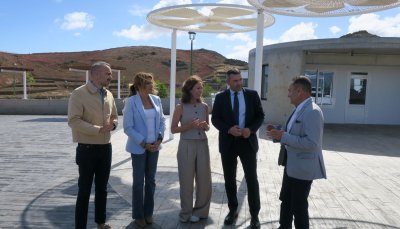
The Minister of Tourism and Employment of the Government of the Canary Islands, Jéssica de León, and the president of the Cabildo de Lanzarote, Oswaldo Betancort, visited this Thursday different actions developed by the island Institution, which the Ministry finances through the EU's Next Generation Funds. Among them, the César Manrique Park and the dissuasive car parks, in Tinajo; the Plaza de Las Palmas or the emblematic Casa Amarilla, in Arrecife, which was the headquarters of the Cabildo de Lanzarote for five decades.
It is a set of interventions that exceed ten million euros and that allow for continued increases in accessibility in the Centers of Art, Culture, and Tourism (CACT), sustainability, or the strengthening of identity in a tourism model that is already a benchmark in the Canary Islands and in Spain.
During the visit, in which the CEO of the public company Gesprotur, Ignacio Solana; the vice-president of the Cabildo de Lanzarote, María Jesús Tovar; the mayor of Tinajo, Jesús Machín, and the councilor for Tourism of Arrecife, Eli Merino, were also present, De León highlighted the importance of these works that strengthen "a tourist destination based on quality. Lanzarote is already a benchmark for the rest of the archipelago, and with these investments we are reinforcing its competitiveness by focusing efforts on universal accessibility and environmental sustainability".
"It's not just about renovating infrastructures," assured the counselor, "but about offering an experience that speaks of who we are, of our identity, and of how our landscape is an inalienable part. In this context, the island of Lanzarote has achieved that nature takes on special meaning, its tourism model serving us as a guide to the rest of the archipelago. It is that successful model that encourages us to continue promoting actions in favor of a sustainable destination."
For his part, the president of the Cabildo of Lanzarote, Oswaldo Betancort, pointed out that "these projects clearly reflect the island model we defend: a Lanzarote that advances from respect for its identity, betting on sustainability, accessibility and quality as pillars of its development" and added that "the support of the Next Generation Funds allows us to accelerate strategic projects that improve our infrastructure and reinforce our way of understanding tourism: balanced, responsible and connected with the territory and with our people".
Betancor also stressed that "every investment we make has the clear objective of improving the lives of those who live here and, at the same time, offering those who visit us an authentic experience, consistent with the values that have made Lanzarote an international benchmark".
For María Jesús Tovar, vice-president of the Cabildo of Lanzarote and head of the Planning and Project Coordination area, these actions "reflect the effort of this Government to address the real demands of the island's residents".
"Both the Las Palmas Square, and the renovation of the Casa Amarilla or the César Manrique Park are spaces that were degraded or that required an immediate intervention," Tovar pointed out, who thanked the Minister of Tourism and Employment "the predisposition to invest in our island."
The mayor of Tinajo, Jesús Machín, highlighted that the municipality has been one of the most recognized in a meeting about the Next Generation funds, for being the town hall that has executed the actions with greater speed. In this regard, he pointed out that he has requested that, if there are still funds available, the area be completed with new facilities such as a playground, in addition to other planned infrastructures such as the Casa de la Juventud and the recovery of a cistern for its use as an exhibition gallery. "I trust that these requests can be met to continue improving the municipality's environment," he noted.
Machín assured that it is a particularly significant work for Tinajo, as the local elderly residence has gained accessibility and will be integrated into a renovated space. He also explained that the project includes a modern playground, with shaded areas, biosafety equipment, a cafeteria, and an outdoor stage. Furthermore, he indicated that the facilities are designed so that the elderly can fully enjoy the environment, eliminating architectural barriers. Finally, he thanked the executing company, Lanzagrava, for meeting the deadlines and the expected quality, stating that El Calvario César Manrique Park will become a top-tier space for the municipality.
Plan for Tourism Sustainability and Destination Cohesion Actions
With an investment exceeding ten million euros, the actions carried out by the Cabildo de Lanzarote are part of the projects included in the Destination Tourism Sustainability Plan (PSTD) Lanzarote 2023-2026 and the Destination Cohesion Actions (ACD).
The bulk of the investment, endowed with 8,215,826 euros, corresponds to the PSTD, a plan that ranges from sustainable mobility and the reduction of energy consumption in the public sector to the recovery of infrastructures in coastal areas and the promotion of traditional gastronomy.
In parallel, two Destination Cohesion Actions (ACD) are being executed. The first of them, with a budget of 438,400 euros, is focused on the elimination of architectural barriers in the Network of Art, Culture and Tourism Centers (CACT). This project includes accessibility diagnostics, staff training, and the development of adapted tools to improve the physical and sensory experience of visitors.
The second ACD, with a budget of 1,500,000 euros, focuses on improving waste management in the tourist areas of Lanzarote and La Graciosa. The actions include the implementation of domestic composting systems, the reduction of food waste in restaurants, and citizen awareness campaigns, in addition to the supply of specific containers.


