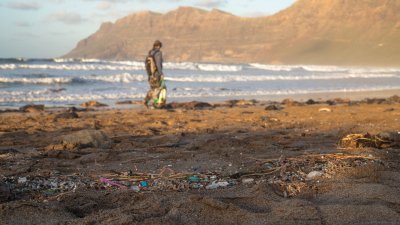
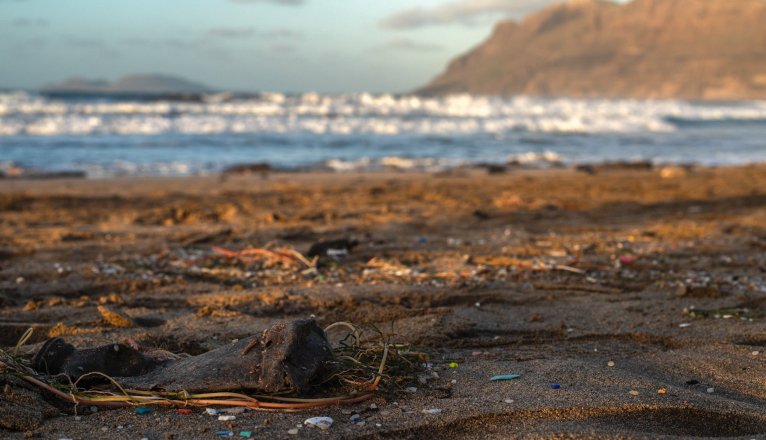
Colored plastics washed ashore by the waves inundate the beaches of Lanzarote. Pieces of caps, bottles, cigarette butts, ropes, and fishing gear mingle with thousands of microplastics that mark the shape of the waves on the shore. A walk on sand and some pebbles becomes a constant effort to avoid stepping on debris.
The warnings about high seas in recent weeks have left a worrying sight. Currents have carried thousands of plastic items to the shore. This image of pollution is seen in Famara (Teguise) and is multiplied on La Cantería beach, known as the back beach of Órzola (Haría), where currents frequently bring tides of microplastics.
The two beaches are known for their strong currents and characteristic waves. However, now the sea not only drags seaweed and stones, but also returns the garbage it receives to the land. In the Canary Islands, some of these wastes that accumulate on the beaches come from the islands themselves, but a large percentage is also dragged by ocean currents to the archipelago. The role of this current is more visible on less frequented beaches.
The Canary Islands' ocean current: an ally for pollution
"The Canary Current, along with eddies and inter-island jets, turns the archipelago into a veritable funnel for marine litter," explains Yarci Acosta, SEO/BirdLife delegate in the Canary Islands, who has been studying marine litter on the islands since 2023. The Canary Islands are located within the North Atlantic Subtropical Gyre, a current system that transports and concentrates floating debris.
Acosta explains that while some of the trash drifts away in autumn and summer, it accumulates in winter and spring. "Due to our position in the Atlantic, we receive trash from very distant places. We are like a natural receiver," Acosta continues. At the same time, he points out that the Plocán platform has detected "an increase in the average speed of the currents in the Canary Islands" and greater changes in their directions, which means "a worsening of the problem."
The accumulation of trash on these beaches is no accident; the RBMar project, which studies the impact of marine litter on the Biosphere Reserves of the Canary Islands, indicates that the north of Lanzarote is one of the areas in the archipelago that concentrates the largest amounts of marine litter. Furthermore, Alegranza and La Graciosa are "very vulnerable" to the accumulation of marine litter.
This project by SEO/Birdlife, with the collaboration of the Canary Islands Oceanic Platform, the Marine Sciences Technology Center, and the University of Las Palmas, monitored marine litter in four Canary Islands Biosphere Reserves: Lanzarote, Gran Canaria, El Hierro, and La Palma.
"This project allows us to know not only what trash arrives, but why it arrives and where it comes from. And that is what we need to act effectively," explains the head of SEO/Birdlife in the islands. In the archipelago, they have detected trash arriving from Canada, the United States, Mexico, or Greenland. However, currents are not the only cause of pollution on the islands.
More than 2,000 objects analyzed in Lanzarote
As part of the RBMar project, three beaches in Lanzarote and two more in the Chinijo Archipelago were analyzed. Among the areas investigated were Alegranza beach, located on the islet of the same name; Montaña Bermeja, in La Graciosa; La Cantería beach, in Haría; Tía Vicenta beach, in Teguise; and Playa Quemada, in Yaiza.
In this investigation, in which more than 2,000 objects were collected along the island's coastline between 2023 and 2025, the focus was not on microplastics, which are particles between one and five millimeters, but rather on trash larger than half a centimeter, which over the years and due to degradation will become the microplastics of the future.
While awaiting global conclusions, the investigation already indicates that beach tourism is the main cause of litter found on Lanzarote's coastline, accounting for 17.5% of the waste. These visitors are joined by those generated by fishing (10.8%), aquaculture (8.3%), navigation (7.7%), and commerce and hospitality (7.7%).
In the five islands and one islet analyzed in the Canary Islands, beach tourism is once again the main cause of pollution, but others such as wastewater (7%) are emerging
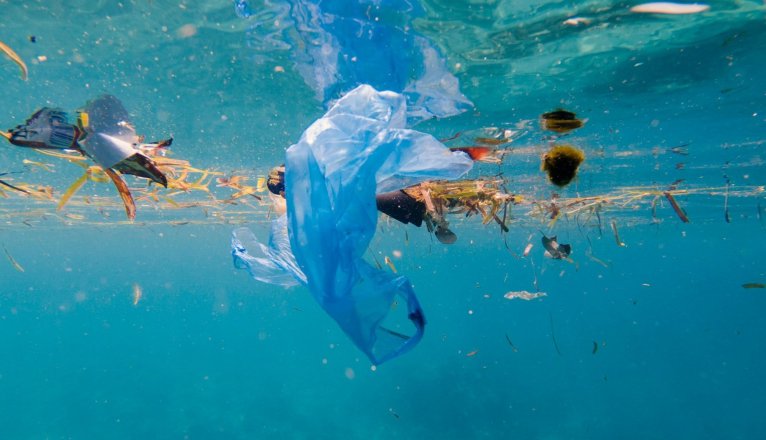
The most prevalent: cigarette butts
Among the 2,000 pieces of trash located in this investigation, the most predominant waste on the beaches analyzed on the island are cigarette butts. "When you throw a cigarette butt down a drain, it's like throwing it on a beach, because the drain communicates directly with the sea," indicates Acosta, who delves into the importance of caring for the environment also from the city.
In addition to cigarette butts, plastic caps, plastic fragments between half a centimeter and fifty centimeters, as well as fishing debris from the North Atlantic are added
Affection for Animals
"Plastics don't disappear, they never disappear, they just keep **fragmenting** into smaller and smaller pieces, becoming available to all kinds of living beings, from plankton to larger animals," the researcher adds. The most common plastics take between 500 and a thousand years to decompose.
Ocean pollution caused by trash generates different impacts on the environment. One of them is the direct effect on marine bird species that search for food in the sea. "We use birds as indicators; the ingestion of a waste product they mistake for food can cause them a feeling of fullness that leads them to die of starvation; since their stomachs are full of trash, they are not hungry and do not eat," adds the scientist.
An investigation published in Environment International in 2024 revealed that most of the shearwaters (Calonectris diomedea) on the islands, a type of seabird found in the Canary Islands and elsewhere in the country and listed by the International Union for Conservation of Nature, have plastic inside them. Of over 1,200 necropsies performed on deceased birds, plastic was found in 90% of the young and adult birds analyzed. There was also plastic in the stomachs of chicks that had not yet left the nest, because their parents ingested it in the open sea and then transferred it to the shearwater chicks.
Ingesting trash is not the only risk for seabirds, which also suffer entanglement or die tangled in debris
What can institutions do?
This expert advises that the fight against marine pollution should be waged by reducing waste production and the consumption of single-use plastic, but also by improving tourism management and strengthening the responsibility of the maritime sector. "What a citizen can do is generate the smallest amount of waste they can," he concludes.


Add La Voz de Lanzarote as a preferred Google source.
Stay informed with the latest current news.