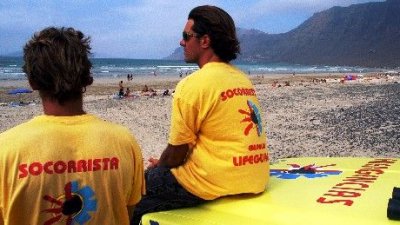
The death of a man in his 50s last Tuesday on Famara beach, despite the attempts of a group of surfers and bathers, who managed to get him out of the water, has been questioned by several witnesses, who claim that the ambulance took too long to arrive, and that only the death of this man could be certified.
The delay of the health personnel could be explained, according to the manager of the Security and Emergency Consortium of Lanzarote, Esteban García, in "the state of the road that gives access to a large part of the beach", as well as in that entering with a vehicle in the sand, even with an all-terrain vehicle, "is almost impossible".
But beyond these explanations, the fact that the bathers had to act as lifeguards reopens the debate on the need to have security personnel throughout the year on one of the most famous and most visited beaches on the island.
"Not even in summer"
The vice president of the NGO Emerlan, Gabino Umpiérrez, is forceful when stating that Famara "is the most dangerous beach in all of Lanzarote and should have lifeguards all year round and not only in summer". According to Umpiérrez, not even in the summer period is the sand properly covered, which has only "three lifeguards like this year". It is a beach of several kilometers "in which at least five, even six people, would be needed, with the support of jet skis and boats".
For the vice president of Emerlan, the "strong and changing" currents of Famara make it a "serious risk" for bathers. In addition, he highlights that "the signage is very bad".
Therefore, he is in favor of "surveillance throughout the year" in one of the best-known beaches in Lanzarote. Umpiérrez states that not even all the rescues that have occurred in the three months of summer have been publicly reported, "so as not to bore people". "Every day there were one or two rescues, even days when there were three and four," he says. In his opinion, only the most complex emergencies and "of course" the deceased were reported.
"There are not enough resources"
Until last September 30, thanks to the agreement with the Emergency Consortium of Lanzarote, lifeguards, ambulances, a rescue vehicle and a jet ski, as well as a boat in La Graciosa and a lifeguard in La Santa, from Emerlan, were working in Famara.
Once that agreement, which was extended during the weekends of November "exhausting the money allocation", points out from the Consortium, Esteban García, is finished, the only thing that has a constant presence on Famara beach is the red flag to which not everyone pays attention. García states that "a permanent service cannot be maintained on all the beaches of Lanzarote because there are simply not that many resources". However, he assures that for the year 2010 they are considering extending the surveillance service from June to November. "But we return to the same problem, the economic resources," he laments.
The only beaches that are covered twelve months of the year are the Pequeña beach of Playa Blanca, the Grande beach, Pocillos and Matagorda in Puerto del Carmen, the Reducto and Las Cucharas in Costa Teguise. "Maintaining that on all the beaches would cost a lot of money," says the manager of the Security and Emergency Consortium of Lanzarote, Esteban García.


Add La Voz de Lanzarote as a preferred Google source.
Stay informed with the latest current news.