
The detainee, a 43-year-old Cuban man who is accused of a crime of professional intrusion, was Navarre's partner for six months, from February to August 2005, and allegedly lacked a university degree in dentistry and was not registered. In addition, according to the Civil Guard, he allegedly caused serious injuries due to recklessness to a total of 30 people and has been accused of fraud crimes amounting to 7,500 euros.
"To open a dental clinic you need to be registered and they ask for the title, in addition to having to arrange papers with Health and with Industry," says Oliver, recalling that these were the steps he had to follow to open the practice. But according to him, although "to work as a dentist it is necessary to be registered, which requires being licensed in the specialty, the title is not always asked for or requested". In his case, he did not ask for it. "I was too trusting in renting the clinic without asking for the papers," Oliver admits, who says he feels "scammed" by the "fake dentist." Now, he says he has learned the lesson and that in the future "if I want to work with a person I will call the College of Dentists to find out if they are registered or not." In any case, he also emphasizes that there are no inspections that control all clinics and that if he takes this measure it will be "on his own initiative."
When at the end of January 2005, the defendant appeared at Oliver's office, because colleagues from the guild told him that he was looking for a person, he did not think that his papers were not in order. "He is a very outgoing person and has a way of treating people that gave me confidence," he says. In addition, according to him, "he was working in a clinic in Playa Honda so I thought everything was in order." The work agreement was verbal, between the two.
Small anomalies
The agreement they reached when they started working together stipulated that, given that Oliver had to be absent for long periods of time in France, his country of origin, the detainee would take care of the office almost entirely. Oliver only spent one week a month on the island. "The week I was here, I worked the days he had free, and attended to some patients." Even so, Oliver was not aware of anything while the working relationship between them lasted. "During those six months, I saw small things that I didn't like, but everyone has their own way of doing things and I didn't give it much importance," he says. Nor did any patient complain during that period, "or if they did, he must have resolved it because I didn't find out about anything."
The first complaints
The first indications that something had not gone well in the office began a month or two after the working relationship with the detainee ended. A rupture that Oliver defines as "brutal" because according to him, after demanding the payment of an invoice, the alleged scammer called him by phone to France to tell him that "he was not continuing and to go pick up the key." Days later, when Oliver returned to Lanzarote, he found that all the utensils in the clinic had disappeared. "I started looking for him and asking people I started hearing complaints," says Oliver. It was impossible for him to find him, and asking patients about his way of working he was surprised that "he did everything too fast and charged a lot," he adds. According to him, "there are things that cannot be done quickly because they have their times," but Navarre believes that "the detainee is a person who surely runs a lot after money."
When in the month of September, his patients began to pass by the clinic to report that some of the actions of O.P.R. were defective, Oliver was fully aware of the alleged scam. "Since he was here, people have been coming complaining about the damages," says Oliver, who regrets having lost money, time and materials in "repairing the damages caused by the defendant to around thirty people."
"If a root canal is not performed correctly, sooner or later it falls out or causes infection problems," explains Oliver, "but it is not something that one realizes immediately, it can take months for that piece to give you problems". This is the case of one of the patients, who told him how he had performed an implant (which Oliver himself does not practice for safety), and that in his opinion "if he did all the implants like that, they will surely all fall out sooner or later." According to the Civil Guard, about thirty patients have been affected, but according to the dentist's experience "cases may still come out."
It comes to light
Almost two years later the news comes to light. The complaint of one of the patients of the Playa Honda clinic has been the beginning of the investigations of the Civil Guard in relation to the possible irregularities committed by the alleged scammer. The Civil Guard contacted Oliver on Tuesday 12, to ask him if he wanted to report him and although he declares that at first he thought about it, so as not to get into more problems before returning to France, in the end he thought "it was the most appropriate."
The arrest, last Thursday, June 14, has been possible thanks to the complaints of three injured patients, including a 14-year-old minor, who suffered serious injuries caused by implants performed by the "fake dentist" according to data from the Civil Guard. In addition, the defendant also worked in another dental clinic in San Bartolomé, in the town of Playa Honda. Once he declared before the judicial authority, the detainee was released with charges, pending the appearance of the injured parties and complainants in the near future. However, the next day he was [arrested again->12584], this time accused of a crime of misappropriation of a vehicle from a car rental company.
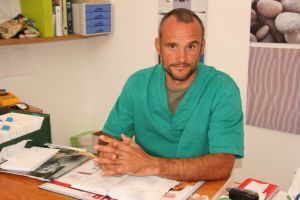
Oliver Navarre. Dentist:"With this type of cases, racism or xenophobia of some people emerges"
Do you think this news has generated fear not only towards your clinic, but in general towards your profession?
Surely, because in this specialty, the trust that the patient places and has for the doctor is very important. Going to the dentist seems like it's always scary, because it's a sensitive part with very uncomfortable pains and you need to have a lot of tact.
And towards your clinic?
That is the fear I have, that the residents of Tinajo believe that I am also a scammer, and that I do not have my title or I am not registered. Some acquaintances have even told me that some people are surprised that the Dental Clinic continues to be open. I am now going to return to France with my family, and I want to transfer the clinic to another person, but although I have not noticed a change in the influx of patients to the office, I am afraid that this case will also affect the next person.
Do you think it has generated another type of feelings due to the fact that the person involved is a foreigner?
With this type of cases, racism or xenophobia of some people emerges. You only have to read the comments of people on the internet from the news. And surely if a Cuban dentist looks for work now he will not find anything, because people do not trust and associate it. But in any case I think it is not good to generalize and just as this type of cases occur also in Spanish doctors, not all Spanish doctors are negligent.


