
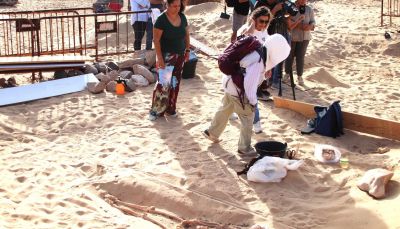
The fourth phase of the archaeological investigation being carried out at the San Marcial de Rubicón site has found bone remains of five people, three adults and two children, as well as a carved stone where a cross found in the same burial area of the bodies is recognized. This new season of the project ends on October 20, in the Los Ajaches Natural Monument, and in which the Government of the Canary Islands, the Yaiza City Council and the two public universities of the Canary Islands participate.
The San Marcial del Rubicón settlement is the first European settlement in the Canary Islands from the 15th century. The initial laboratory analysis of the first bone remains found dates the body to a period between 1408 and 1445, that is, 615 years ago, "but as the person consumed a lot of marine diet during their life, it is likely that complementary studies will place the date a little more recently," explains archaeologist María del Cristo González, from the University of Las Palmas de Gran Canaria, who has been leading the investigation since the first phase together with Esther Chávez, archaeologist from the University of La Laguna.
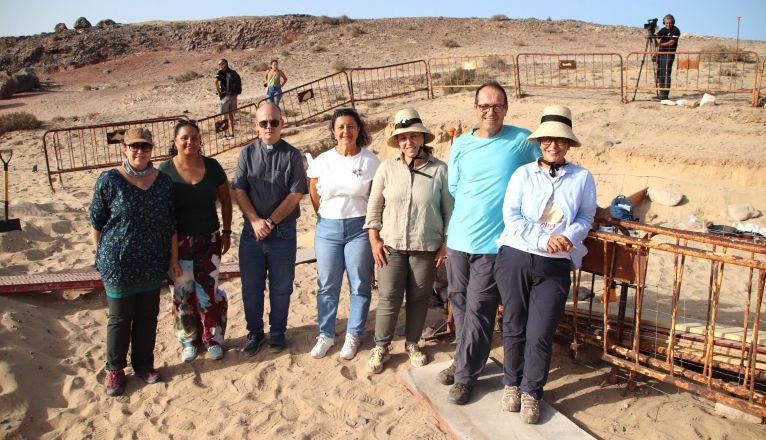
González highlights that "the remains appeared in an area where we really did not expect, because we found them far from the cathedral, they were located in front of the cross on the other side of the ravine." The councilors of Yaiza Silvia Santana and Águeda Cedrés, from the Heritage and Environment areas, respectively, toured the site this Tuesday together with the two directors of the project in the company of the parish priest of Yaiza, Jonathan Almeida. "The municipality of Yaiza is committed from minute zero to this project and we have the unconditional support of our mayor, Óscar Noda, to maintain the investigation alongside all the entities that support and finance it," emphasizes councilor Silvia Santana.
Restoration expert
The research team includes Patricia Prieto Angulo, restorer of the Cueva Pintada Museum and Archaeological Park of Gran Canaria, in charge of restoring the coins found in previous phases. Patricia Prieto is now taking care of the essential parts of the bone remains for DNA analysis and their subsequent removal and thus give continuity to the work in the laboratory. Experts point out that any movement could disarticulate the skeleton and this would mean the loss of information.
It should be remembered that the research group had so far found buried work structures, habitat, defensive structures and coins from the time of this enclave in the Rubicón, which shows the first contacts between European and native Canarian culture.
And there is also new news about the habitat: "relevant a wall that closes the 'neighborhood' or colonial habitat found last campaign, which we discovered in our search for new areas with buildings that explain the existence of a city with the characteristics of San Marcial de Rubicón." Scientists are looking for new habitat areas and archaeological remains on the road that leads to the wells.
Regarding the stone with a cross carved in low relief, the archaeologist María del Cristo González specifies that "last year, following the trail of an anomaly indicated by the georadar, this year we found two accumulations of parallel stones that in principle seemed to be the delimitation of the burial of a person." Indeed, the investigation found these stones next to the feet of a skeleton, "then we decided to cover it and we have returned to that place to unearth the complete bone remains, which has turned out to be a woman." When carefully dismantling the stone structure, the researchers found the stone embedded almost vertically where a cross is clearly recognized.
The next phase of the investigation will continue in 2024 with underwater surveys that were pending from the second phase. "Now we have the necessary points to intervene in the search for possible submerged remains," González notes. The company Baraka Arqueólogos, with the archaeologists Miguel Ángel Hervás and Luis Alejandro García, and a group of five workers from the company Lumar are also participants and important actors in the investigation.


