
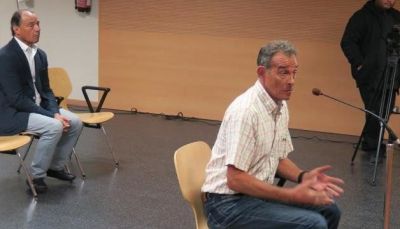
"We said that we were going to inspect the complex" and "there was no problem until the moment we entered the winery." There, according to what the head of the Technical Office of Yaiza, Antonio Lorenzo, declared this Wednesday, the businessman Juan Francisco Rosa contacted him by telephone to instruct him to end the inspection and leave the property. "But he didn't call my cell phone as you say," Antonio Lorenzo replied to prosecutor Ignacio Stampa. "I'm not saying it, the local police report says it," the prosecutor specified to Lorenzo, who was testifying as a witness in this trial.
In any case, although the technician has denied what the agent who went to the inspection recorded in the report, he has confirmed that the telephone conversation did take place. And that it was just when they were going to enter the winery, after having spent about an hour at the Stratvs complex, accompanied by an employee of Rosa. "We arrived and they put a person at our disposal," he said. But "after an hour," according to Lorenzo, "a man appeared" with a telephone and told him that Rosa wanted to speak with him.
"And why did you decide to leave?" he asked. "Because I understood that I could not enter if I did not have permission from the property," the witness replied. "Does an inspection require authorization from the property?" Stampa insisted. "I don't know," the head of the Technical Office of Yaiza ended up answering, adding that he "may have an incorrect legal understanding" about whether that permission was needed or not. And he also confirmed that after leaving Stratvs, he did not notify anyone at the Town Hall of what had happened or that they had ended the inspection without even entering the winery.
From defendant to witness
In his statement, Antonio Lorenzo himself recalled that he was charged in this case, although the charges against him were eventually dropped. During the investigation, the members of the Yaiza Governing Board stated that Lorenzo was present at the meeting in which the classified activities license was granted to Stratvs, but the technician was later able to certify that he was on vacation on that date. He did participate in the inspection ordered by the mayor, Gladys Acuña, just after declaring as a defendant in this case, and also in the initiation of the files, although he ended up recusing himself when he also became investigated for a time.
When asked by the lawyer for the private prosecution, Antonio Lorenzo stated that "they did not consult any document" before going to inspect Stratvs: neither the projects presented by the businessman, nor the licenses, nor the file. And after the visit, he stated that they were "basically looking at" one, the equipment and facilities project, but not the construction project or the execution project.
Regarding why the Town Hall ended up ordering only the closure of the restaurant, in line with what Acuña stated last Monday, the technician pointed out that this facility did not have a construction license, or an execution project, or an activity license, or a commissioning project. In other words, not a single document that would support its construction, much less its commissioning.
"And the restored house?" asked the lawyer for the private prosecution, Irma Ferrer, referring to the protected house that Rosa requested permission to rehabilitate, and which, according to the investigation, ended up being demolished and a larger one built. Regarding it, Lorenzo confirmed that it housed a store and a "cafeteria" - which would also have required a specific classified activities license - and that it also did not have a first occupancy or commissioning license, although the Town Hall did not take any measures until the entire complex ended up being closed by the Investigating Court.
Confirms that the complex did not have a commissioning license
Regarding why no action was taken on the rest of the facilities, the mayor and one of the former Urban Planning councilors accused, José Antonio Rodríguez, alleged that it was due to a lack of technicians, since both Antonio Lorenzo and Andrés Morales - also accused in the case - recused themselves in the files, and the former secretary was removed from office due to another judicial conviction. In addition, they pointed out that the case of the restaurant was "very clear", as it did not have a single paper, but that in the rest it was necessary to respond to the allegations of the property.
However, the head of the Technical Office confirmed this Wednesday that although for part of the construction there was an authorization from the Government of the Canary Islands - specifically for a 900-meter winery and for the rehabilitation of the pre-existing house - the truth is that neither the execution project nor the final certificate of the work was presented, which ended up occupying about 12,000 square meters. And it also did not have a commissioning license, which is the one that should have been granted after the activity license, whose concession is what is being judged in this piece of the Stratvs case. "Without all that, can it be opened?" asked the lawyer for the private prosecution. "No," the technician replied.
Antonio Lorenzo also had to answer the magistrate who presides over the Chamber of the TSJC, who, among other things, asked him if he knew why it took "so long" to carry out an inspection visit after the classified activity license was granted. This is because that license, granted in December 2008, established, among other conditions, that the activity could not be started until an inspection visit was carried out - whose purpose is to verify that what was built conformed to the project presented - and the commissioning license was obtained, which never happened.
And despite this, Stratvs was operating even before obtaining the conditional permit in December 2008. In fact, the mayor and several councilors of her Governing Board attended the inauguration party of the winery seven months earlier, in May 2008. An event that they referred to as a "presentation" party, assuring that they did not know that it was already operating and that they did not detect that there was a restaurant and a store in addition to the winery.
"No, I don't know," Lorenzo replied to the judge's question about the reason for that "delay" in carrying out an inspection, which actually arrived five years later and after the indictment of Gladys Acuña. "The verification visit is made after the owner provides a series of documentation. It can be done before, but it is not usually done," added the technician. "Were you invited to the inauguration of Stratvs?" asked the lawyer for the private prosecution. "I don't remember. I don't think so."
"The documentation must have an entry record, at a minimum"
The head of the Technical Office has also answered questions related to issues that were already raised during the first day of the trial. Among other things, he pointed out that "the documentation that is part of the file must have an entry record, at a minimum." This clashes head-on with what happened with the file to grant the activity license to Stratvs, in which reports that had been sent by fax from the Rosa Group and that did not even pass through the Town Hall Registry or were verified were incorporated, according to what the defendants themselves confirmed in their statements.
In addition, the prosecutor also asked him about another of the defendants who was also a Councilor for Urban Planning when the activity license was granted, Leonardo Rodríguez. "Is it normal that Rosa's requests, presented nine days earlier, related to other files, were found in his office?" Stampa asked. "No, in principle no," replied the technician, who had previously explained that a councilor can have a file in his office if he requests it for some reason.
Finally, Lorenzo also spoke about the urban situation of that land, confirming what he had already reflected in a report that he sent to the mayor and that was seized by the UCO during a search within the Unión case. In that report, in which he has ratified, he pointed out that "what is not in the Island Plan does not exist", also with "relation to permitted and tolerated activities". And in the case of the Stratvs winery, it is not included or permitted by the PIOT, which is the one that determines the uses in rural land. "It is a supra-municipal instrument and you cannot go against that document," Lorenzo stressed. "And was the General Plan in force adapted to the Island Plan?" the magistrate who presides over the Chamber asked him again. "No," replied Lorenzo, who even, when asked by another lawyer, pointed out that not even the General Plan allowed the construction of a winery on that land.


