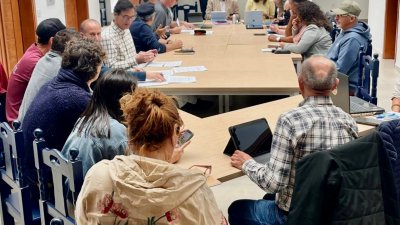
The Sociocultural Center of Caleta del Sebo, in La Graciosa, hosted on March 26 the meeting of the Joint Commission for the management and monitoring of the marine reserve of fishing interest of La Graciosa and the islets north of Lanzarote, a meeting in which a historic agreement was reached for the traditional fishing sector of both islands that will allow improving the management of the census of vessels authorized to engage in maritime fishing professional in the area, guaranteeing the rights of currently authorized vessels and those with a home port located within the space, while allowing professionals from the Fishermen's Guild of Playa Blanca, in the south of Lanzarote, to fish occasionally and in a limited way in the territory under strict control and monitoring conditions, including vessel geolocation.
Participating in the session were the general director of the Fisheries of the Government of the Canary Islands, Esteban Reyes, and the deputy general director of Fisheries Research and Data Collection of the Ministry of Agriculture, Fisheries and Food (MAPA), Elisa Carbajo, in addition to representatives of the fishermen's guilds of La Graciosa, San Ginés (Órzola and Arrecife, Lanzarote), La Tiñosa (Puerto del Carmen, Lanzarote), and the spokesperson of the Regional Federation of Fishermen's Guilds of the Canary Islands, the National Federation of Artisanal Fishing (FENAPA), David Pavón, as well as technical staff of the of the administrations and of these entities. Also attending were the counselor of Environment, Landscape, Biosphere Reserve, Hunting and Fishing of the Cabildo of Lanzarote and La Graciosa, Samuel Martín, and the councilwoman of Agriculture, Livestock and Fisheries of the City Council of Teguise, Myriam Jorge Camejo.
The general director of the department, Esteban Reyes, explained that “this agreement benefits the sector of both islands and responds to demands that had been made by professionals for many years. In this way, the rights and interests of all parties are guaranteed and a more inclusive management is adopted, without excluding fishermen from any guild or port of both islands, which will contribute to improving the perception of the fishing sector about the important benefits of these protected marine areas and could facilitate the establishment of new reserves of interest in other areas of the Archipelago”.
Two main axes of the agreement: census of authorized vessels and another complementary list
The agreement is structured around two main axes: on the one hand, the census of vessels authorized to engage in professional maritime fishing in the reserve will be divided into two lists, a fixed one drawn up with criteria of regularity and proximity (made up, mainly, of habitual local vessels with home port in Caleta del Sebo (La Graciosa) and Puerto de Órzola (Lanzarote), in addition to the boats that make up the current census) and another complementary list made up of all vessels with a port located on both islands that are not included in the main enumeration and that may take turns weekly to fish in the area. On the other hand, for the first time, workers from the Playa Blanca Fishermen's Guild will be allowed to fish in the marine reserve, at least occasionally and under strict control and activity monitoring measures.
The proposal was drafted by a working group made up of professionals who carry out their activity in the area and which includes the staff of the brotherhoods of La Graciosa, San Ginés and La Tiñosa, in coordination with the Regional Federation of Fishermen's Brotherhoods of the Canary Islands and with the technical support of the General Directorate of Fisheries.
The marine reserves of fishing interest are fishing protection zones provided for in Law 17/2003, of April 10, on Fisheries of the Canary Islands, and in Law 5/2023, of March 17, on sustainable fishing and fisheries research, intended for the protection and recovery of fishing and shellfish resources, as a measure to support the local and regional artisanal sector, through the limitation of uses and activities that usually take place within them. To this end, a spatial delimitation is established and technical measures are adopted to guarantee the favorable state of the resources and the provision of a permanent control, surveillance and monitoring service with suitable means to carry out the work effectively.
In this way, all these spaces contain at least one integral reserve, of maximum protection (where only actions for scientific purposes and innocent passage navigation are allowed), restricted use zones (in which highly selective fishing can be practiced) and moderate use zones with more open purposes, in addition to a census that regulates the vessels that have access to the reserve. With all this, this agreement ensures the conservation of the marine ecosystem and the sustainability of island artisanal fishing while guaranteeing the protection of the marine resources of the Chinijo archipelago and the social and economic viability of this area.
This agreement has been the key axis of the meetings held between last March 23 and 26 within the framework of the Shared Management Agreement for Marine Reserves in the Canary Islands signed between the General Directorate of Fisheries of the Ministry and the General Directorate of Sustainable Fisheries of the General Secretariat of Fisheries of the Ministry of Agriculture, Fisheries and Food (MAPA). In these meetings, in which representatives of the interested guilds and their corresponding federations also participate, as well as of the Cabildos and Municipalities involved at a territorial level, the aim is to respond to the requests and needs of the sector.
In this regard, in addition to this last meeting, a meeting took place on March 24 to address the state of the La Palma marine reserve, managed exclusively by the State due to it having no internal waters and because the practice of shellfish gathering is prohibited. Attended, along with Esteban Reyes, Elisa Carbajo and David Pavón, representatives of the brotherhoods Nuestra Señora del Carmen (Tazacorte) and Nuestra Señora de Las Nieves (Santa Cruz de La Palma) and the mayor of the Tazacorte City Council, David Ruiz. The following day, March 25, the follow-up meeting of the La Restinga Point Marine Reserve, Sea of Las Calmas, in El Hierro, took place, which was attended by representatives of the brotherhoods Nuestra Señora de Los Reyes (ports of La Restinga and La Estaca), the president of the Cabildo de El Hierro, Alpidio Armas, and the councilwoman for Primary Sector Development of the El Pinar City Council, Jaisan Morales.
In these meetings, in addition to delving into different proposals and evaluating the specificities and needs of the sector and its sustainability, the need to reinforce the frequency of this monitoring was highlighted to facilitate communication and streamline the adoption of key measures to promote generational change and improve the social perception of the reserves.
In parallel, the General Directorate of Fisheries of the Government of the Canary Islands has established as a medium-term objective the establishment of at least one marine reserve of fishing interest on each island. Furthermore, since 2021 it has been promoting several participatory workshops with the different departments (nautical and fishing, both professional and sport-recreational) and the carrying out of scientific and technical studies in the surroundings of the islet of Lobos and the Strait of La Bocayna, between the islands of Fuerteventura and Lanzarote, to evaluate the potential and viability of the area for the creation of a new marine reserve with broad social support.
Furthermore, collaborates closely with the Directorate General for Sustainable Fisheries of the Ministry of Agriculture, Fisheries and Food for the realization of studies that update scientific and socioeconomic information with the aim of establishing new reserves on the islands of La Gomera and Tenerife through assignments to Tragsatec, a company of the Tragsa Group and an in-house provider for public administrations.



Add La Voz de Lanzarote as a preferred Google source.
Stay informed with the latest current news.