
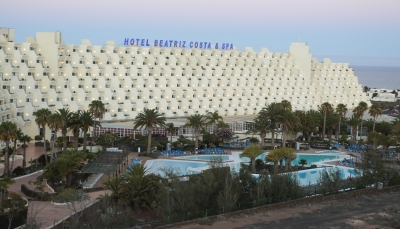
More than a dozen hotels in Lanzarote have requested authorizations in the last year to install private desalination plants in the different tourist establishments on the island to capture, desalinate water and discharge the brine, that is, the surplus of hypersaline water and chemical products, into the sea.
The problems with the company awarded the comprehensive water service of Lanzarote, Canal Gestión, and the continuous supply cuts have served to study the installation of private desalination plants in different complexes.
The Paradisus by Meliá Salinas hotels in Costa Teguise; the Costa Calero in Puerto Calero; the Elba Lanzarote Royal Villages Resort and the SBH Royal Mónica, the H10 Timanfaya Palace, the Hotel Iberostar Selection Lanzarote Park, in Playa Blanca; the La Isla y el Mar Hotel Boutique, the Riu Paraíso Lanzarote, the Hyde Park Lane, the Beatriz Playa & Spa, both in Puerto del Carmen; are some of the hotel establishments that have requested authorization in the last year to install a private desalination plant in their establishments. In some cases, the authorization is still in the public information phase.
Meanwhile, the Sol Lanzarote hotels, in Puerto del Carmen, and Sands Beach Resort, in Costa Teguise, as well as the Hotel H10 Rubicón Palace, in Montaña Roja, have requested to renew the administrative authorization to continue desalting water.
In addition, other hotel establishments such as the Hotel Floresta, in Puerto del Carmen, have requested the modification of the authorization for the capture of desalinated water.
Most desalination plants will be able to discharge between 300 and 680 cubic meters of brine per day into the marine environment. However, the discharge of saline water into the sea causes damage to the marine environment and affects the species that inhabit it. Already a study prepared by the Institute for Water, Environment and Health of the United Nations University (UNU-INWEH), Wageningen University (Netherlands), and the Gwangju Institute of Science and Technology (South Korea) revealed that "better brine management strategies are required to limit negative environmental impacts and reduce the economic cost of disposal".
Likewise, an investigation prepared by the two public universities of the Canary Islands, already revealed this year that large tourist flows "tend to concentrate in time and space in traditionally arid and dry regions", that is, in sun and beach destinations. This leads to an "overexploitation of local resources" and an intensification of water consumption.


