
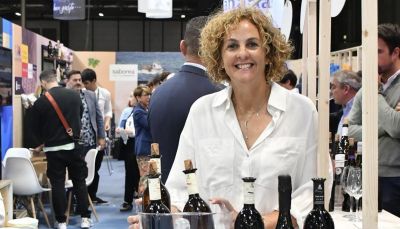
Ana de León from Lanzarote is the manager of Bodegas Los Bermejos, a winery that always opted to compete on quality and not on price. Today its wines can be found in stores and restaurants in Madrid and Barcelona, but also in Japan and the United States.
De León, a firm defender of the cultural and landscape value of traditional cultivation in holes, explains in an interview with the program Más de Uno Gourmet of Radio Lanzarote how Bodegas Los Bermejos has managed to diversify its markets to become today one of the main exporting wineries on the island.
- What has been your career path to becoming the manager of Los Bermejos?
Los Bermejos has two partners and I started working about 30 years ago with the partner who came from the construction branch. I was in charge of the administration of his company.
Over the years he decided to acquire the facilities where Bodegas Los Bermejos is today. I had been in Madrid for a year to study and have a little more experience in large companies. They called me and I returned to Lanzarote to join in 2007.
- The winery's production has grown a lot since 2007, which was a difficult time for Lanzarote wine...
I am very fortunate that Bermejos' policy has always been clear. From the beginning I knew what the guidelines were and where I had to go.
When Ignacio Valdera opened the winery, he decided that he was going to make a gourmet wine, which was going to be in restaurants and Horeca channels.
- How has the perception of Lanzarote wine changed in recent years?
I remember the first years, when you sat in a restaurant and it was hard to see a Lanzarote wine on the menu. Our cultivation system makes it impossible for us to compete on prices. Hence the commitment to compete on quality.
Over the years, the Regulatory Council began to bet on what Bermejos and other wineries that joined were doing, and who were also very clear about where we had to go. That's how many actions were taken. We sent tasters from the wineries to hotels and restaurants to show that the wine, even if it was more expensive, was going to work on the menu. Today it is very difficult to sit in a restaurant and not have Lanzarote wine.
"Both Priorat and Ribeira Sacra have special aid for their heroic viticulture. In Lanzarote not yet."
- What size are your farms?, are they semicircular plantations?
Between the two partners they have around 23 hectares in operation and 14 more that are currently in plantation.
The ones we have around the Casa de los Carrascos are in a semicircular system.
- You are a great defender of traditional cultivation in holes, have the subsidies announced by the Cabildo to support it already been introduced?
I always say that Lanzarote wine is living a golden age because it has this unique cultivation system in the world. All the expeditions, on July 19 we are bringing an American expedition, they come only to live the experience of what it is to cultivate in a hole and we cannot lose that.
European aid arrives per hectare, regardless of how they are cultivated. It is not logical that the person who is going down a hole, whose yield per hectare is 500 or 600 kilos, charges the same as the person who is going to get 1,500 kg per hectare by planting in line. The work involved has nothing to do with it.
Only 5% of the vineyards in Europe are heroic viticulture, including the vineyards in holes of Lanzarote. In Spain, both Priorat and Ribeira Sacra have special aid for this type of vineyard. In Lanzarote not yet.
"By diversifying markets, in the pandemic we were able to send wine to Japan"
- How does Bodegas los Bermejos become the great wine exporter it is today?
When I arrived, the winery had distributors for the Canary Islands and one in Gipuzkoa. With my incorporation we started attending fairs to diversify markets and give more structural stability to the company.
Thus, during the pandemic, we were able to send wine to Japan or the United States.
- How have you managed to reach so many corners of the United States?
The United States is quite special for import. Each state needs a different license, so we sell it to an importer in New York who includes it in his portfolio and he is the one who then looks for distributors in each of the states.
- Do you have direct contact with end consumers in the different states of the United States?
Yes, all the time. The New York importer organizes a fair every year, where all the wineries in the world that he includes in his portfolio participate and to which buyers from the different states come.
As they know that it is very difficult for me to get there (laughs), they take advantage of the week that I am there and they send me to different states and that is how I meet the local distributors of the importer. I have done seminars in wine shops, visits to stores, restaurants...
"In the United States we sell 90% of our rosé"
- Is the American customer demanding?
I really like their way of working because they are demanding and super prepared, but they never question the price. They really value the Lanzarote product when they see this cultivation system that we have. They simply tell you if it fits them or not.
- What wine sells the most?
In general, the Lanzarote wine that sells the most is the dry volcanic malvasia, but in the United States, in addition, we sell 90% of our rosé.
"The forecasts for the 2024 harvest are not good at all"
- How many bottles do you produce per year?
The harvests in Lanzarote are quite cyclical, they change a lot from one year to another, but we try to keep our average between 500,000 and 600,000 bottles per year, although there are vintages in which we stay below 400,000.
- What are the forecasts for the 2024 harvest?
The forecasts are not good at all, the budding is uneven and it is not being as abundant as we would like. In fact, the insurance companies are already analyzing the situation.


