
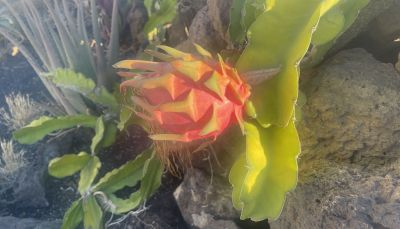
In recent years, there is a plant that has conquered many Lanzarote residents, who cultivate it on their land to enjoy its tropical flavor. This is the pitaya, a climbing cactus native to Central America that arrived in the Canary Islands as a fruit plant in 2005.
The pitaya has economic development potential in Lanzarote, since its cultivation fits perfectly with the island's climate, requiring very little water. The fruit is attractive to international consumers and highly profitable, as the few farmers who produce it for sale are obtaining up to two and a half euros per kilo.
However, most of Lanzarote's production is for self-consumption. Only a few dozen farmers have been encouraged to produce it for sale. From the Lanzarote irrigation community, they explain that for the pitaya market to grow, "it is necessary for the administrations to develop market studies and have support measures."
The virtues of the pitaya
The pitaya fruit stands out for its organoleptic properties and its high content of antioxidants.
"The pitaya attracts attention, has properties, many people like it, and it is very easy to know when it is at its point of maturation by the appearance of its flowers. Also, it can be preserved, since its fruit stays quite well after being harvested," explains the president of the Lanzarote irrigation community, Leandro Caraballo.
"It is a fruit that offers a lot of possibilities, since it can be used as a fruit and in salad. Also, we know how to do it very well on the island, since being a cactus, its water needs are very low. There are also no pests or diseases that affect the plant on the island yet," adds Caraballo.
Furthermore, he continues, "a well-maintained farm can yield 3 or 4 kilos per square meter throughout the year because flowerings occur two or three times in a row." Currently, it is one of the fruits that gives the most profit margin in Lanzarote, between 2 and 2.5 euros per kilo.
Lack of institutional support
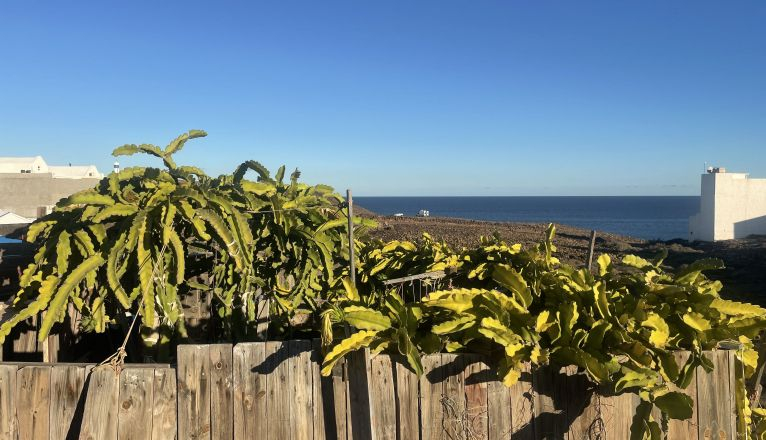
However, according to the sources consulted, there is still no farm on the island that exceeds 5,000 square meters of pitaya cultivation.
The president of the irrigation community attributes this to the lack of information and a plan by the administrations that includes "subsidies and price guarantees" so that farmers dare to make investments, as with other consolidated crops on the island such as potatoes or grapes.
"There must be coordination between production and market opening or failure is assured, because if production grows without adapting to the markets, prices will fall and therefore its profitability," explains Caraballo.
On the other hand, "cultivation management investments are also necessary to achieve a certain flavor, with more precise fertilization techniques, that is attractive to the consumer, because there are many people who like pitaya, but others find it bland," explains the president of the irrigation community. Additionally, "studies are still lacking on how the desalinated water of Lanzarote affects the quality of the product," he adds.
The journey of the pitaya to Lanzarote
In their book The cultivation of pitaya, the technicians of the Cabildo of Tenerife, where the first cuttings were investigated for their introduction in the Canary Islands, explain that although "the pitaya is originally from the forests of Central America, it has spread to many other places. One of the first that is known is Vietnam, where it was taken by the French more than 100 years ago and from here it was transferred to the French island of Reunion.
However, its interest as a food crop does not arrive until the 80s, they explain in their book. From Vietnam it arrives in Australia and Thailand to be later introduced in the United States, Israel, Argentina and New Zealand.
Although the pitaya already existed in some gardens of the Canary Islands where it was cultivated for its flowers, the first pitayas for its cultivation as food were brought in 2005 by Professor Victor Galán Sauco, from the Canarian Institute of Agricultural Research from the French island of Reunion and also from Guatemala. First they were cultivated on the farm of the Cabildo of Tenerife. Very soon some cuttings were taken to the farm of the Cabildo of Lanzarote, from where it has spread throughout the island.
Whether the Lanzarote pitaya consolidates as its own product and later goes to international markets will depend on more island farmers being encouraged to cultivate it. For this, the support of public administrations will be essential.


