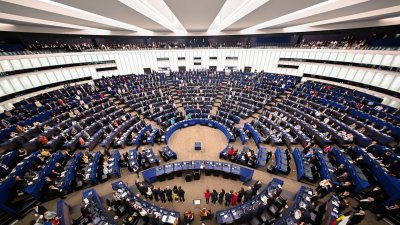
The European Parliament will ask to maintain a specific fund with an allocation of 6.5 billion euros for the outermost regions of the bloc, among which is the Canary Islands, within the EU budget for the 2028-2034 period, in contrast to the original proposal in which it disappears.
This emerges from the agreement reached between political groups that make up a comfortable majority in the Hemicycle ahead of this Wednesday's vote in which MEPs will take their first step to set their red lines for the negotiation of the next EU Multiannual Financial Framework (MFF).
The draft budget that the European Commission put on the table last summer does not include a specific fund for the nine outermost regions of the EU, which are, in addition to the Canary Islands, the French French Guiana, Guadeloupe, Martinique, Mayotte, Reunion, Saint Martin and the Portuguese Azores and Madeira.
In this way, funding that until now was managed by the fund called POSEI would be included, according to Brussels' proposal, in the country funds that collect allocations for various programs such as the Common Agricultural Policy (CAP), regional Cohesion funds or resources for fisheries.
In practice, this would leave the decision of how much to dedicate to each of these priorities in the hands of the Member States, but the European Parliament advocates in its negotiating position for including specific allocations for each of them so that each priority has guaranteed specific resources.
Specifically, the report that will be put to a vote tomorrow foresees a budget of 6.5 billion for these regions as part of the broader CAP allocation, which would mean maintaining the current level of resources for these regions.
"The European Commission initially proposed to eliminate it completely. We believe that would be wrong," defended MEP Sigfried Muresan of the European People's Party (EPP), one of the two rapporteurs for the resolution, at a press conference this Tuesday.
In his opinion, the nine outermost regions are especially important for the entire bloc, especially "in the current geopolitical context," and therefore the EU "should not leave Spain, Portugal, and France alone" in efforts to protect and develop these enclaves.
In any case, this stance will constitute, once approved, the European Parliament's negotiating position for the next long-term EU budget, which Member States must also approve, in their case unanimously.
Once tomorrow's vote is over, the European Parliament plans to confirm its red lines in another vote during the plenary session at the end of this month.
In parallel, Member States continue to advance at a technical level to agree on their negotiating position, something they want to achieve in the best-case scenario before the end of 2026 but which seems complicated because it requires the support of the twenty-seven capitals in negotiations that are always very divisive.



Add La Voz de Lanzarote as a preferred Google source.
Stay informed with the latest current news.