
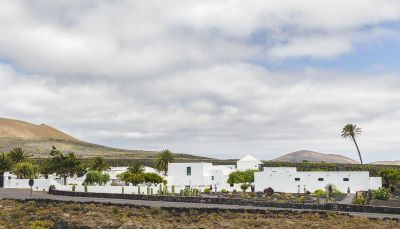
Throughout its 247-year history, El Grifo has faced the eruption of a volcano, water scarcity, strong trade winds, and the difficulty of mechanization, which has imprinted values such as courage and resilience in the winery's DNA.
Its latest historical milestone, unique on a European scale, is to bring forward the harvest (in Lanzarote it takes place between July and August) and carry it out earlier than anywhere else in the northern hemisphere, specifically between the last week of March and the first week of April.
The reasons are closely linked to the winery's own character, as well as to research and science, that is, to the analysis carried out by the oenologists Jorge Rodríguez and Lorena Díaz, and the advisor Xabier Kamio.
In order to expand knowledge about viticulture on the island, the technical team has carried out an experiment on a plot located in the lowlands of the island to learn about the active cycle of the vineyard during the winter.
The objective is to protect the vineyard against climate change in the near future due to the increase in temperature to which different wine-growing areas in Lanzarote are being subjected; to try to maintain unique vineyard cultivation systems, pre-phylloxera and heritage of humanity; to work on the continuous search for solutions for winegrowers and to create knowledge for future generations.
In the history of El Grifo, the role of winegrowers is key, such as the person in charge of the plot, Francisco Raimundo García, with a professional career of more than 25 years, from whom the idea of the project originated.
The plot is located in the town of Playa Quemada, in the municipality of Yaiza. It is the closest to the sea that El Grifo currently owns, 1,950 m in a straight line from the Atlantic. Therefore, Finca Playa Quemada was ideal for the study because it is located in the lowlands of the island, where temperatures suffer very little variation and the cultivation cycle can be developed during the winter months.
Thanks to this project, firm conclusions have been drawn in favor of sustainability through the reduction of the consumption of natural resources, for example, lower consumption of water resources by the plant since they are the coolest seasons and less use of plant protection products given the lower development of pests and diseases. The active cycle of the vineyard during autumn and winter has been known in depth, being able to change it and obtain grapes for winemaking with greater aromatic potential and freshness, that is, producing fresher wines, with greater oenological potential and adapted to the new horizons of climate change, taking advantage of the favorable climatic conditions for the development of the vine that occur in Lanzarote in autumn and winter.
Not only that, but also the Finca Playa Quemada project will allow the production of the first harvest of winemaking grapes in Europe during the natural vegetative rest cycle of the vine, as in other areas of the world, such as India, where there are wineries that have changed their vegetative cycle in order to avoid over-ripening of the grapes. Without forgetting that another key premise of this winery in the hands of bold men and women is the continuous search for unique, emotional wines that are deeply linked to the culture of Lanzarote. In this case, the technical team of El Grifo persevered in the project with the desire to obtain a fresh wine in one of the most desert places on the island.
The awaited fruit of a historic harvest will be a small production of unique Volcanic Malvasia, which will undoubtedly mark a before and after in the wine sector of Spain and Europe.


