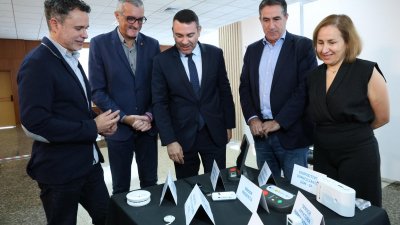
The Canary Islands Government presented this Tuesday at the Cabildo of Lanzarote the new advanced telecare system that is already being implemented on the island and in La Graciosa, and which will initially serve almost 800 people with dependency.
This was indicated by the Deputy Minister of Social Welfare, Francis Candil, and the Director General of Dependency, Concepción Ramírez, who held a press conference on the island alongside the president of the Cabildo de Lanzarote, Oswaldo Betancort, and the island councilor for Social Welfare and Inclusion of the insular institution, Marci Acuña.
The event was also attended by some of the labor staff from the island's Social Welfare Area, as well as a representative from the company Atenzia, which will manage the home care for residences where GSM-IP home devices, advanced sensors, and mobile devices are installed. These devices, costing €22.7 million, have been financed through the Recovery and Resilience Mechanism, the key tool within the European Next Generation EU funds to boost post-pandemic recovery in Spain and the EU.
The advanced telecare service of the Canary Islands Government not only consists of the installation of technical equipment, but also includes home visits to people who require telecare, assessment of the type of equipment needed for specific individualized care, installation of the technical equipment in the homes of dependent individuals, and the periodic and coordinated assistance required for this type of home care.
In Lanzarote and La Graciosa, this new system represents a quantitative and qualitative improvement in telecare, increasing from the 133 dependent individuals attended in 2025 (another 29 currently receive basic telecare through the service provided by the Cabildo itself) to a projection of nearly 800 people during this fiscal year. In the Canary Islands, this advancement in telecare will mean a fivefold increase in the number of people who will benefit from advanced means for their care in their private homes, reaching approximately 20,000 dependent individuals.
Improved Dependency
The Deputy Minister of Social Welfare of the Canary Islands Government, Francis Candil, has explained that the improvement in the dependency system in the Canary Islands is evident, with outstanding reductions in the processing times for people requesting assistance. He stated that "we can assure that, in Lanzarote, we are already below the legal processing time, as we are resolving cases in 140 days, while the law establishes the maximum time at 180 days".
For her part, the Director General of Dependency, Concepción Ramírez, explained that **in Lanzarote there are 2,291 people on payroll with dependency aid, that there are 609 people waiting for this teleassistance aid and that currently only 133 receive it**, with which the reach will increase notably with this new system”. In fact, as she stated, the current waiting list for teleassistance will disappear before the summer.For his part, the president of the Cabildo of Lanzarote, Oswaldo Betancort, highlighted that the implementation of the new advanced telecare service represents "a decisive step in the modernization and humanization of the public care system," moving from a model focused solely on emergency response to a preventive, personalized, and close one that accompanies people in situations of dependency in their daily lives. "With actions, not words; and with coordinated work with the Canary Islands Executive, we are managing to improve the lives of the most vulnerable people," he stated
Councilor Marci Acuña thanked the Government of the Canary Islands for choosing Lanzarote and La Graciosa for the regional launch of the advanced telecare service, "a commitment to the Island of Care that responds to a mandate from the current Canarian Executive and provides users with cutting-edge technology that reinforces the work of our professionals. This represents a qualitative and quantitative leap in the service," he emphasized. Furthermore, Acuña highlighted the improvements made on the island during this term in terms of dependency, noting that in 2023, assessments were carried out in an average of 900 days, and this has now been reduced to 430.
The increase in the current number of people who have telecare services will favor an improvement in their quality of life in an early stage of dependency, as well as an improvement in daily care and the provision of assistance and security resources within the home that offer a safer and more efficient service.
Advanced telecare is part of a shock plan for the care economy and reinforcement of inclusion policies, and the plan for long-term support and care through deinstitutionalization, a strategy being carried out by European mandate to favor the permanence of people in situations of dependency in their environment. This would imply reducing the need for residential places, with early intervention, which will prevent the need for hospitalization of dependent individuals
This improvement in technical means offers a series of key benefits:
- Continuous Monitoring: The devices allow for constant tracking of the person's status and location, thanks to GPS tracking systems and mobile network connectivity, enabling a quick and effective response in case of emergency.
- Prevention of risky situations: Using motion sensors, the devices can automatically alert the monitoring center or designated contacts, even if the person cannot request help themselves.
- Greater peace of mind for family members: Caregivers and family members can remotely monitor the well-being of the dependent person, which reduces worry and stress related to continuous care.
- Improvement of personal autonomy: Elderly or dependent individuals can maintain greater independence, knowing they have immediate access to assistance in case of need, allowing them to continue their daily lives without sacrificing their safety.
This way, a more accessible, rapid, and efficient coverage is facilitated, contributing to the deployment of a personal autonomy support system that responds in a modern way to users' needs in a personalized and adapted manner to their specific conditions. Thus, it is ensured that the elderly and dependent population in the Canary Islands accesses a comprehensive service that promotes their well-being and safety within the framework of public services.



Add La Voz de Lanzarote as a preferred Google source.
Stay informed with the latest current news.