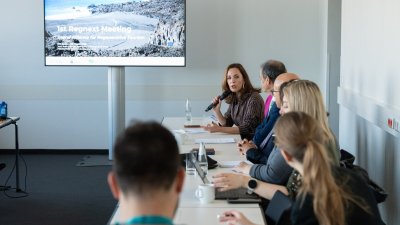
At the ITB Berlin, the selection criteria were established for the four pilot projects that will be executed, one on each island with greater tourist pressure (Lanzarote, Gran Canaria, Tenerife and Fuerteventura), to which a fifth of a transversal social nature will be added.
The RegNext program is based on the idea that, "if tourism is the main economic engine of the archipelago, it can also become a structural engine of its regeneration," explained the sector's counselor, De León.
It is a public-private initiative, the Alliance for the Regeneration and Renaturalization of the Canary Islands, with the participation of international and Canarian operators such as TUI, easyJet, Skyscanner, Untours Foundation, DERTOUR, Lopesan and Loro Parque, as well as Ashotel and representatives of island councils.
Also attended The Travel Foundation, an international organization leading the fight against climate change in the tourism sector and a strategic partner of Turismo de Canarias in the design of RegNext.
“This first working meeting represents a decisive step after the formal constitution of the alliance at Fitur,” assured the Minister of Tourism and Employment, Jéssica de León. “Now we already have a draft that gathers the criteria to choose those five projects that will have an environmental and also social character,” added De León, who clarified that both public and private entities, NGOs, groups and associations will be able to present their proposals.
"We want a high citizen participation to take place that joins the whole of the tourism sector, which has created a common front coordinated with public and private capital to execute these initiatives that will be beneficial for the entire archipelago."
As agreed in the meeting, projects must have a tangible impact, clear technical and economic viability, and measurable and visible results for Canarian society. To this end, environmental requirements will be applied, such as the effective restoration of priority habitats and the measurable improvement of biodiversity, as well as social criteria, such as the generation of local green employment, training and capacity building.
The program's design also incorporates a legal and administrative framework with independent audits and clear and viable tax advantages for participating operators.
Furthermore, the counselor explained that the Government of the Canary Islands is already working to «offer legal coverage that guarantees complete traceability from the contribution to the execution of the projects, with the aim that every euro reaches its destination, since the contribution is voluntary and earmarked», explained the counselor.
Likewise, a digital platform will be launched that will offer a simple experience for tourists, residents, and businesses, where the status of the projects can be viewed. “Each user will be able to see which initiative is being worked on, companies will be able to see where each euro is allocated, and an exact explanation will be offered of which private entities contribute money in order to achieve responsible communication and marketing,” explained De León, who detailed that “the final step, which will be launched in 2027, will be for tourists to also donate to these projects if they so choose.”
The Nature Restoration Regulation established by the European Union makes the restoration of degraded ecosystems a legal obligation and establishes that at least 20% of terrestrial and marine areas be undertaken before 2030 and all before 2050.



Add La Voz de Lanzarote as a preferred Google source.
Stay informed with the latest current news.