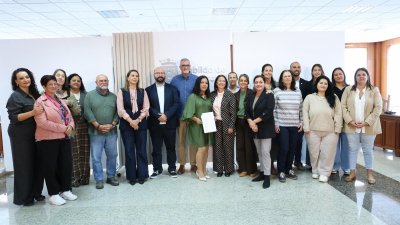
The Plenary Hall of the Cabildo of Lanzarote was the scene this Wednesday morning, coinciding with the International Day of Persons with Disabilities, of the joint signing of the Protocol of Institutional Commitment for an Accessible and Inclusive Lanzarote and La Graciosa, a historic document that marks the beginning of coordinated work between the Institution presided over by Oswaldo Betancort and the seven town councils of the island, with the aim of advancing in a coordinated manner in matters of inclusion, universal accessibility, and guarantee of rights.
The signing of the Protocol was attended by the island councilor for Social Welfare and Inclusion, Marci Acuña, as well as the councilors for Social Services and other public representatives from the seven Lanzarote municipalities. Also, due to the significance of the signing, **numerous Third Sector groups** were present.
It should be noted that these entities acquire their own voice in the planning and evaluation processes of the actions and projects to be carried out under the umbrella of the Protocol. Furthermore, during the event, an audiovisual piece was also screened to support this action to guarantee the rights of people with disabilities in Lanzarote and La Graciosa.
The Institutional Commitment Protocol for an Accessible and Inclusive Lanzarote and La Graciosa continues the Strategy for Accessibility and Inclusion of Disability in Lanzarote and La Graciosa, approved in plenary session in November 2024 and promoted by the Department of Social Welfare and Inclusion. This strategy constitutes an insular roadmap with more than 100 measures structured around seven axes, covering areas from social care and education to tourism, employment, citizen participation, and awareness.
The Minister of Social Welfare and Inclusion, Marci Acuña, has highlighted the importance of "not working in isolation," emphasizing that today "the Cabildo and town councils are taking a decisive step to coordinate our public policies on accessibility and disability," not relying on occasional impulses, but on a stable, coordinated, and shared commitment among all administrations. "Lanzarote and La Graciosa are moving towards an island model where no one is left behind, on the Island of Care," he said.
In addition, Acuña stressed that both the Strategy approved in 2024 and the Protocol endorsed this morning with the island's town councils "allow us to work with a common vision, based on equal opportunities, real participation, and the construction of environments that respect the dignity and autonomy of all people."For his part, the president of the Cabildo of Lanzarote, Oswaldo Betancort, has valued the agreement as "an example of institutional cooperation that continues to position Lanzarote as a benchmark in its commitment to sustainable and inclusive development; setting clear commitments in the document signed today that are assumed by the parties, such as the development of municipal inclusion plans, among other useful measures," he commented.
An instrument with concrete policies
The signed document establishes a common framework for Arrecife, Haría, San Bartolomé, Teguise, Tías, Tinajo, and Yaiza, along with the Cabildo, to work together in promoting a more accessible, just, and equitable society.
Among the commitments made are the creation of an Insular Technical Committee, the development of municipal accessibility plans, and the integration of universal design criteria in urban, tourism, cultural, educational, and social projects. The protocol is based on guiding principles such as universal accessibility, design for all people, social inclusion, active citizen participation, and transparency in evaluating progress.
The Institutional Commitment Protocol is open-ended, allowing the accession of new public or private entities that share its principles and objectives. Likewise, it contemplates the elaboration of annual monitoring reports and the definition of common indicators to evaluate the degree of progress



Add La Voz de Lanzarote as a preferred Google source.
Stay informed with the latest current news.