Photos: Sergio Betancort
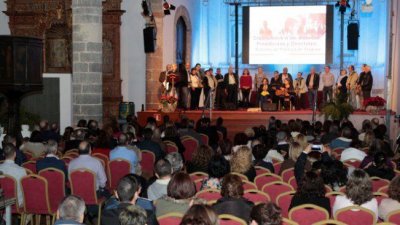
The Santo Domingo Convent of the Royal Villa de Teguise hosted on Friday night a heartfelt and well-deserved tribute to the family of the greatest exponent of the Christmas tradition of Teguise: the Rancho de Pascuas, a cultural symbol and religious-musical heritage that performs every Christmas Eve in the Church of Nuestra Señora de Guadalupe after the staging of the Mystery of the Birth of Jesus.
"This is the public and notorious recognition of the true custodians of our essence. The Rancho de Pascuas of Teguise is a source of pride for the people of Teguise and that is why we want to thank all its members for the work they do in order to preserve our heritage, which gives us identity as a society," declared the mayor of Teguise during his speech. "In short, an explicit recognition of a tradition that reflects deep social values, which represents the union of an entire people in pursuit of helping the most disadvantaged. Blessed feast and blessed union," concluded Oswaldo Betancort.
The act of awarding distinctions to the directors of the Rancho de Teguise, framed within the celebration of the 600 years of history of the Royal Villa de Teguise, began with the historical review of the official chronicler, Francisco Hernández, as well as with the performance of the guest Rancho, Los Arbejales de Teror.
A total of nine directors received, -some from the hand of their relatives-, recognitions for their work in coordinating the Rancho de Teguise throughout its history. Juan Crisóstomo García, Marcos González Armas, Manuel Cabrera Morales, Manuel Cabrera Rodríguez, Marcos de León González, Zenón Ventura Perdomo, Antonio González Batista, José Manuel Fontes Herrera and Oliver Martín Hernández.
Corrido, saltos, desechas and Pascuas
The Rancho de Pascuas is a relic of the religious-musical traditions of Teguise. It was the Franciscans who brought the tradition of the Ranchos de Ánimas to Teguise. There was in Teguise a book of the Cofradía de Ánimas, in which the masses, the prayers, the collections and the songs and alms contributed by the Rancho were noted.
The Ranchos de Ánimas toured the streets of Teguise, asking from door to door, to raise money to pay for masses and to build coffins to bury the poor. They went out in the month of November and from the day of Santa Lucía (December 13), the Ranchos sang to Christmas, continuing their performances until the feast of the Candelaria on February 2. The Ranchos also participated in the so-called masses of light, which took place from December 16 to 24, always at dawn.
Don Juan Crisóstomo García was for many years director of the Rancho de Teguise. In 1897 he had collected in a notebook several of the songs that the Rancho currently performs. By limiting the performances of the Rancho de Teguise only to Christmas, it is why it is no longer known as Rancho de Ánimas, but as Rancho de Pascuas.
"Our generation heard the voices of Manuel Cabrera, Zenón Ventura and Antonio González, we carry them recorded as a treasure that, without a doubt, is part of our religious-musical heritage," says the official chronicler of Teguise, Francisco Hernández.
The Rancho begins its performances with the CORRIDO, which it does when entering the Church and announcing the Birth of Jesus, continues with the SALTO, which is a dance of shepherds who celebrate the Nativity, continues with DESECHAS and ends with the PASCUAS.


Add La Voz de Lanzarote as a preferred Google source.
Stay informed with the latest current news.