
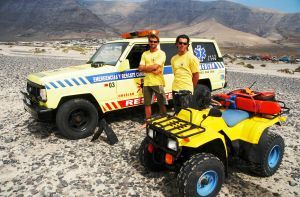
This June 2nd, a young British man was rescued in the waters of Famara by Emerlan volunteers who had been required to cover the filming on the beach of Pedro Almodóvar's latest film. The quick intervention was successful, most likely due to the physical presence of these lifeguards. A few days before, the current had pulled the body of a German citizen from the water, for whom nothing could be done.
Many beach users, who include walkers, bathers, and lovers of various water sports, demand a permanent surveillance service or, at least, an extension to the months when the beach begins to be visited by a greater number of people, which could be May, June, and, after the summer, October.
Bungalow for surveillance
The Teguise City Council is promoting the initiative to install a wooden post in Famara for permanent beach surveillance, "but we are still studying this matter and looking at the requests we have to make to Costas so that in the future there will be a permanent person," explains councilor Eduardo Tarajano. For the time being, the surveillance service is limited to the three summer months covered by Emerlan volunteers
The Head of Security of the Teguise City Council, Eduardo Tarajano, specifies that "the Emerlan guys usually go to Famara fifteen days before and usually leave fifteen days later, so in reality the service operates for more than three months."
The councilor also reported on the work that the Corporation is carrying out on a bungalow located on the beachfront in order to condition it and turn it into the headquarters of the Famara surveillance services, so the Emerlan device would work from that space from the month of July. "It is located in the middle of the beach and we are restoring it to create a post prepared for emergencies there", declares Tarajano, who hopes that the works will be completed in July, "although everything will also depend on the technical procedure," he warns.
He points out that the agreement with the Non-Governmental Organization (NGO) amounts to a subsidy of 30,000 euros to cover Famara beach, but also other beaches in the northern strip, such as Caleta de Caballo or the island of La Graciosa during the Carmen festivities, for example. The councilor admits that in the case of Famara, "we have to be aware that this beach is dangerous, due to the currents. All year round it has the red flag, which stays halfway up due to the constant wind, but it is there. If you notice, most of the events happen with people from outside, who do not know the beach".
Emerlan
The information, therefore, would be a crucial point to, at least, warn users of the characteristics of the beach. In fact, the City Council does not rule out the possibility of providing data on the currents of Famara reflected in cartographies of the beach that the General Directorate of Coasts manages.
The coordinator of the Underwater Intervention Group of Emerlan, Dionisio Pérez, agrees with this vision, who comments that the most appropriate action on Famara beach "is to inform a lot and explain how to act in difficult moments, because to cover that area they could use at least 20 lifeguards, many. You can enjoy the beach, but with care, taking extreme precautions."
He explains that "Famara is a very peculiar and complicated beach. It is not one hundred percent suitable for swimming. There are local currents that you have to know to know how to deal with them and get out of them if you find yourself trapped, because the current takes you out, but then it returns you. The most convenient intervention would be prevention, with lifeguards and with a lot of information to people who do not know the beach, that they do not leave the breakers and that they do not fight against the currents. Information is vital," he concludes.
Emerlan has been working in Famara for at least seven years. In the area, during the summer months, it deploys an 'all-terrain' vehicle, an ambulance, a quad, a jet ski and, on occasions, a boat. This year, the Local Police of Teguise will also have a quad vehicle. Two lifeguards go to the beach every day and stay there from 9 a.m. to 6 or 7 p.m., but this service is reinforced on weekends. Professionals intervene an average of four times a day in Famara and 85 percent of the cases are due to bathers or athletes who cannot get out of the water. The rest are minor cures.
Emergencies and Rescue of Lanzarote currently has 80 volunteers in daily activity. Their training and recycling, as well as self-training, is constant. It has a Mountain Rescue Group formed by 12 professionals, and an Underwater Activities Group, also integrated by 12 divers. As for material resources, it has four ambulances and other specialized vehicles.
SURVEILLANCE TOWERS EVERY 400 METERS
Cruz Roja Lanzarote communicates that the establishment of possible coverage in Famara "is very difficult to do at first sight, since the most appropriate thing in these cases is to make an exhaustive study of the characteristics of the beach and its risks." According to Luis C. Carrasco Cabrera, Head of Communication and Image of Cruz Roja, "the fundamental problem is that currently there is no state or regional regulation in the Canary Islands that regulates these aspects and to determine them we have to resort to making analogies with similar cases or foreign regulations. There was in the Canary Islands decree 98/2003, which determined in a fairly clear, but also very strict, way, the necessary surveillance means for the beaches, but it was repealed a few months later by 289/2003. Although it never came into operation in Cruz Roja we would also take it as a reference document if we had to determine the necessary service for Famara".
According to Luis Carrasco, "in the case of Famara, which at first sight would be a high-risk beach, that decree required a service coordinator and surveillance towers every 400 meters with present lifeguards, in addition to other lifeguards for health care, surveillance on foot of water and rescue boat, and even recommended a graduate in medicine and a graduate in nursing".


