
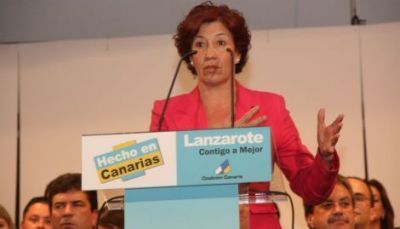
The Minister of Social Welfare, Youth and Housing of the Government of the Canary Islands, Inés Rojas, highlighted that more than 8,000 families from the Islands have requested emergency housing aid from the regional Executive, which is intended to prevent evictions or pay water and electricity bills.
Rojas, who appeared today in plenary at the request of the Popular Parliamentary Group (PP) to report on the evolution of the Canary Housing Plan in the face of the economic and real estate crisis, received congratulations from the three parliamentary groups: Canary Coalition, Popular Party and Socialist Party for her housing policy. In her speech, she stressed that it is the "most powerful" Plan in the entire State, which is mainly aimed at families with less than 18,000 euros per year.
She recalled that the Canary government had already foreseen the crisis and therefore decided to allocate 4 million euros to emergency aid to municipalities. "They are the ones who know the reality of the families and who can deal with a situation of eviction, or that of people who do not have the minimum in their homes, etc.", she said.
Rojas pointed out that the Government already has the reports from the town councils which reflect that more than 8,000 families from the Islands will be able to benefit from this money, which the Executive has already advanced to the local corporations.
She also highlighted that another of the measures taken by the Canary government within the Housing Plan focuses on granting 3,000 euros to each landowner who builds protected housing. "This reactivates the economy: allowing construction to continue, employment in the construction sector is recovered and the most disadvantaged families have a larger stock of properties", the councillor specified, while pointing out that more than 5,000 owners have applied for this subsidy.
She also recalled that another of the Executive's commitments has been for town councils to acquire private land so that protected housing can be built and that is why, she continued, "almost 3,000 houses are currently being built in the Canary Islands since last year and the new 2008 competition for 3 million euros has been closed".
Along these lines, she announced that the Government is going to buy land in Agaete (Gran Canaria) to build 56 homes, in La Guancha (Tenerife) for 39 homes, in Puerto del Rosario (Fuerteventura) for 24 and in Valverde (El Hierro) to build 10.
SUCCESS
She also emphasised that the public company Visocan has put out to tender the acquisition of 1,000 homes that are no more than 50 percent built or from people who have the licence but for whom it is not profitable to build them now. "The competition has been a success in response, as more than 1,600 homes have been received, although only 700 met the requirements to be susceptible to purchase by Visocan", the councillor pointed out, while adding that "given that the Government has availability to complete 1,000 homes, it has agreed to the acquisition competition of 300 more homes".
The deputy of the Socialist Parliamentary Group (PSC-PSOE), María Eulalia Guerra, congratulated the Government of the Canary Islands for the measures it has promoted for housing, both the current plan, which is about to end, and the 2009-2012 plan, but asked the councillor to also value what is being done by the Government of Spain.
Along these lines, she recalled the rental aid from the Zapatero Executive, which is added to that given by the Canary Islands. She explained that the PSOE is as concerned about housing as the Canary government and encouraged Inés Rojas to continue taking measures for housing and the people who need it.
GREAT EFFORT
The deputy of the Popular Parliamentary Group (PP), Carlos Ester, underlined the "great investment effort" of the Ministry of Social Welfare at this time of crisis, compared to the "blow" in the budgets that has come from the Government of Spain, which has also reduced the items in housing by two million euros.
For Ester, the regional Executive is betting on an investment that "takes away from us that of Spain", because among other things - he continued - it has not ceded any land to create housing.
He also described the housing policy of the Zapatero government as a "failure", which is demonstrated in "the changes in the portfolio", and criticised that it is now promoting 30 square metre houses for couples.
CANARY ISLANDS, A PIONEER
The councillor, in her second speech, thanked the three groups in the House for their congratulations on the housing policy of the Canary government. She agreed with the PP deputy that no land has been bought in the Canary Islands by the Government of Spain and the State's items in this area have decreased by 26 percent and "that is why we have told the minister, Beatriz Corredor", she explained.
She reminded the PSOE deputy that the Canary Islands is a "pioneer" in taking measures in housing, especially in youth policies, as she indicated that since 1998 "there have been young housing exchanges in the Archipelago that all the autonomous communities admire and ask us how we have done it".
ACN Press


