
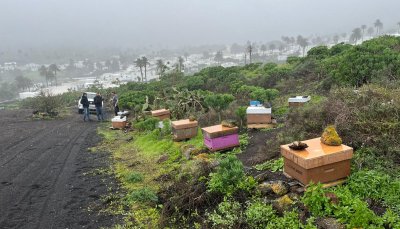
The Lanzarote Island Council and the La Palma Island Council are collaborating to strengthen the development of beekeeping in Lanzarote and ensure the conservation of the native Canary black bee, a native breed that is key to the ecological balance of the Archipelago.
A working meeting took place this Thursday at the headquarters of the Presidency of the Cabildo de Lanzarote, attended by the island president, Oswaldo Betancort; the Minister of Agriculture, Livestock, Fisheries, and Food Sovereignty of the Cabildo de La Palma, Alberto Paz; and Elías González, president of the Animal Health Defense Group (ADS) linked to honey production in La Palma. The meeting served to advance coordination between both institutions and facilitate contacts between beekeepers' associations on both islands.
President Oswaldo Betancort has insisted on the importance of this initiative for the island's primary sector and for the protection of natural heritage: "Beekeeping in Lanzarote is taking firm steps and needs institutional support to continue growing with guarantees. The understanding with La Palma allows us to bet on a sustainable activity, protect the Canarian black bee, and generate new opportunities for our producers."For his part, the councilor from La Palma, Alberto Paz, highlighted the strategic value of cooperation: "It is essential to maintain exhaustive care of the Canary black bees for their purity and their key role in pollinating the native flora of the Canary Islands. With this agreement, we are generating a direct relationship with Lanzarote to preserve and improve beekeeping at a regional level."
An emerging activity with great environmental value
Beekeeping in Lanzarote is currently in an emerging phase. Eight producers operate on the island, with over 300 hives, mostly located in the north of the island. It is an activity that, although it presents a limited but high-quality honey production, plays an essential role in the pollination of local agriculture and in maintaining ecological balance.
With the declaration of the black bee reserve in the Canary Islands, which prohibited the importation of other breeds to the Archipelago, it was established that islands such as La Palma, Lanzarote, and Fuerteventura – later joined by Gran Canaria – would act as reference territories for future strategic projects.
In the case of Lanzarote, the development of beekeeping projects can now find strong support in the Palmera black bee, which is ideal for feeding and strengthening existing hives on the island. Lanzarote beekeepers will be able to receive queen bees, with the aim of creating their own nuclei of the Canary black bee and avoiding hybridization processes
The original objective is to select the best queen breeders from La Palma, with guarantees of genetic purity, productivity, docility, and, above all, adaptation to the environment; and for this reason, it has already been decided that specimens from the south of the "Isla Bonita" will be brought to Lanzarote.
During his visit to the island, Elías González, president of the Apiculturists' Health Defense Group of La Palma - a sector that brings together more than 108 members and 3,400 beehives - learned firsthand about the operation of some of the Lanzarote beehives, a tour he took with Manuel Zerpa, president of the Lanzarote Beekeepers' Association, and Aldo Román Gutiérrez, veterinarian of the Lanzarote Insular Agrarian Service.
Each hive installed in a natural environment represents the daily work of thousands of worker bees, whose labor is fundamental for pollination and the strengthening of flowering, with a direct impact on agriculture and island ecosystems.


