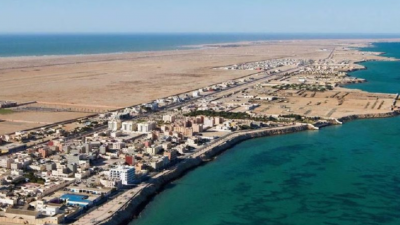
The president of the Port Authority of Las Palmas, which includes the Port of Arrecife and the president of Astilleros de Canarias, the largest naval industry in the islands, toured the port of Agadir (Morocco) this week on a visit marked by the mixed feelings with which the Canary Islands maritime sector views its neighbors and competitors: between suspicion and opportunity.
The port was the last stop on the three-day trip made by the President of the Canary Islands, Fernando Clavijo, to the city of Agadir, at the head of the largest delegation from the islands to date to Morocco: 60 institutional and business representatives, many of them from the port sector.
The figures for the port of Agadir pale in comparison to those of its Canary Islands rivals. The Port of La Luz in Las Palmas de Gran Canaria alone handles almost five times more cargo: 32 million tons, compared to seven million. (Arrecife handles 2.1 million).
Nevertheless, the two Port Authorities of the Canary Islands (that of the province of Santa Cruz de Tenerife was also present) did not want to miss the opportunity to learn about the expansion and growth plans of Agadir.
For years, the Canary Islands have viewed Morocco with distrust, for reasons including the Western Sahara conflict, as most of the islands' institutions support the self-determination of the Sahrawi people and oppose Rabat's claims over that territory, which it considers part of its country for all intents and purposes.
Clavijo changed that paradigm in October 2024, during his first of three trips to Morocco, when he went to Rabat to seek support in tackling the severe migratory crisis the islands were experiencing, with hundreds of makeshift boats departing from Moroccan coasts.
That day, he was asked in Rabat about the shift by the Spanish Government regarding Western Sahara, recognizing Morocco's idea of turning the territory into an autonomous region as the most viable and realistic proposal to resolve the historic conflict.
"I know that is news, and it has been made perfectly clear that the Government of the Canary Islands fully adopts the policy of the Spanish Government," he replied. His statements shook Canary nationalism, even his own party, Coalición Canaria, which has many supporters of the Polisario Front and the Sahrawi cause.
Each trip by a Canary delegation to Morocco or Western Sahara has been viewed from that perspective: it happened during the commercial mission of the ports of Las Palmas de Gran Canaria and Santa Cruz de Tenerife to Dakhla, in Western Sahara, and it has happened again now with the trip to Agadir.
From Nueva Canarias, the other Canary nationalist force, its general secretary, Luis Campos, and the president of the Cabildo of Gran Canaria, Antonio Morales, have accused Clavijo of "whitewashing the occupation" of Western Sahara with his rapprochement with Morocco and of feeding a strategic and economic rival, thus jeopardizing, in their opinion, the leading role of the port of Las Palmas in the Mid-Atlantic.
At the beginning of the visit, Clavijo expressly referred to "the pressures" that he knew, he said, had been exerted on several delegation members to prevent them from accompanying him to Agadir. And twice during the trip, he emphasized that the Canary Islands cannot remain on the sidelines of the economic development that Morocco, its neighbor, is experiencing, opting instead to "bury their heads in the sand."
Two key economic sectors in the Canary Islands have this dual perspective when looking at Morocco: tourism (also present on the Agadir mission) and the maritime port sector.
Those responsible for the latter acknowledged in various informal conversations during the trip their interest in knowing the details of the port of Agadir: such as its depths, the tonnage of its cranes, or whether the meteorological conditions on the Souss Massa coast would facilitate or hinder operations there with large container ships.
On the ground, this Wednesday, January 28, they saw that no, that Agadir is a port very oriented towards fishing (the second most important in Morocco in that field), but with notable growth plans in infrastructure, both in berths and shipyards.
Without even leaving its docks, the presidents of the Port Authorities of Las Palmas, Beatriz Calzada, and Santa Cruz de Tenerife, Pedro Suárez, agreed in statements to the press that Agadir would not be a competitor. It does not have the conditions for it, they added.
Moreover, they believe it can be a complementary port to theirs to try to jointly attract maritime traffic to the Mid-Atlantic that does not usually pass through this area. Dakhla, in southern Sahara, is another matter, they specified.
Due to its depth and, above all, the millions of investments that Rabat has announced in its infrastructure, Beatriz Calzada and Pedro Suárez do fear that Dakhla will indeed be a competitor sooner or later.
But they do not blame Morocco. The great threat to the ports of Las Palmas and Santa Cruz de Tenerife, they say, are the new CO2 emission taxes that the European Union has imposed on maritime traffic.
In the case of the Canary Islands, they warn, these could encourage shipping companies and agents to avoid them by replacing calls at the large ports of the islands with those in Morocco.


Add La Voz de Lanzarote as a preferred Google source.
Stay informed with the latest current news.