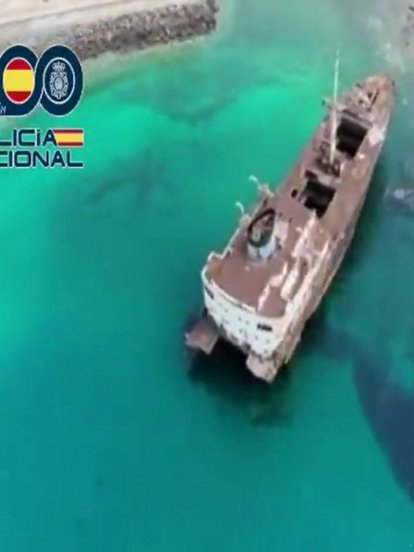
National Police agents have dismantled the largest network of **cocaine trafficking organizations** that **dominated the Atlantic and Spanish rivers** using "narco-speedboats".Agents have carried out a total of 49 searches and arrested 105 people who formed a criminal network in an operation that had the collaboration of the NCA, DEA, DGSN, EUROPOL, MAOC-N, and authorities from France, Portugal, Colombia, and Cape Verde. Among these searches, **a total of fourteen** were conducted in Lanzarote.10,400 kilos of cocaine, seventy vehicles, thirty boats, six properties, three firearms, over 800,000 euros, two hexacopters, multiple bank accounts, over 150 mobile phones, various nautical equipment, and numerous state-of-the-art electronic devices for maritime trafficking valued at 2,500,000 euros were seized
They operated at night
After more than a year of investigation led by Central Investigating Court 3 and the Special Anti-Drug Prosecutor's Office of the National Court, the operational phase was carried out last November, managing to **dismantle a criminal network specialized**, allegedly, in introducing large quantities of cocaine into Spanish territory via high-speed boats known as "narcolanchas." They departed from the Guadalquivir River and other rivers belonging to the provinces of Cádiz, Huelva, Almería, the Canary Islands, the Moroccan coasts, and Portugal to **enter the Atlantic Ocean**
There they would meet mother ships to transfer the narcotic substance for its subsequent return to the Canary Islands archipelago and the southern peninsula
The high speeds of the vessels, sometimes exceeding 40 knots, and the use of encrypted communications, satellite terminals, hard-to-trace mobile phones, or coded language to avoid detection by security forces, allowed them to operate during nighttime hours, hindering police efforts
Attack on the logistics center
The organization's structure extended from Galicia, Portugal, Huelva, Cádiz, Málaga, Almería, Gerona, and Ceuta, through Morocco to the islands of Lanzarote, Gran Canaria, Fuerteventura, and Tenerife. A total of 49 entries and searches were carried out with the participation of the Special Operations Group –GEO– and the Special Security Operations Group –GOES–
Specifically, they were carried out in – **Lanzarote** (fourteen), Gran Canaria (fourteen), Fuerteventura (2), Algeciras (11), La Línea de la Concepción (7), Jerez (2) where 70 vehicles, 30 boats, six properties, multiple bank accounts, three firearms, more than 800,000 euros, two **hexacopters**, numerous cutting-edge technological materials such as high-frequency jammers, WIFI amplifiers used to expand the signal at sea, satellite connections, more than 150 mobile phones, many of them encrypted, and nautical equipment have been seizedAmong all the seizures, the largest money laundering and asset distribution center in Campo de Gibraltar has been targeted, responsible for supplying secure communication terminals to most of the drug traffickers in Andalusia and various navigation equipment for the "narcolanchas" crossings
More than a month at sea
They even created true aquatic platforms where pilots would remain at sea for over a month, carrying out several successive operations. They timed the exact moment for crew changes while at sea, and supplied these platforms with the goods and services they required.
They had their own fuel storage centers, with the use of over 100,000 liters being demonstrated. Smaller vessels were responsible for supplying both gasoline and provisions, communication equipment, or even clothing for the notaries who accompanied the drugs from the mother ship to our country.
Other members of the organization located at checkpoints carried out surveillance tasks to determine the position of maritime and air assets of the State Security Forces and Corps, covering a wide network of security points along the coast.
Twelve million euros for silence
The agents became aware that the organization paid twelve million euros to the family of one of the deceased crew members in a drug shipment to ensure their silence and thus avoid any connection with criminal activities.
Thanks to the collaboration of agencies such as the National Crime Agency (NCA), the United States Drug Enforcement Administration (DEA), the Moroccan Directorate General for National Security (DGSN), Europol, the Maritime Analysis and Operations Centre – Narcotics (MAOC-N), and authorities from France, Portugal, Colombia, and Cape Verde. Furthermore, there was direct support from the National Intelligence Centre – CNI –.
This operation was carried out in two phases, the first of which culminated in June of last year with 48 people arrested and 29 searches in Lanzarote (14), Gran Canaria (13), and Fuerteventura (2), leading to the seizure of approximately 100,000 euros, nearly 3,800 kilos of cocaine, 69 vehicles -19 boats and jet skis-, six properties, bank accounts, three handguns, numerous documents, and various tools for maritime trafficking such as satellite phones and geolocation devicesIn a second phase, completed in November of last year, 20 searches were carried out – 11 in Algeciras, 7 in La Línea de la Concepción, and 2 in Jerez – where over 700,000 euros, two hexacopters, various nautical equipment, and numerous cutting-edge technological materials were seized – frequency jammers, WIFI amplifiers, and satellite connections – successfully dismantling this criminal network that operated in the Campo de Gibraltar with the arrest of 57 people as alleged perpetrators of the crimes of belonging to a criminal organization and drug trafficking
Investigations have revealed that this criminal organization was responsible for introducing 57,000 kilos of cocaine into Europe in the last year. It had coordinators in Morocco, Cádiz, and the Canary Islands responsible for receiving and distributing narcotics from Colombia and Brazil, with Portuguese authorities intercepting 6,600 kilos of cocaine aboard a semi-submersible.
Operation co-financed by European Funds from the Internal Security Fund
National Police agents, with the collaboration of EUROPOL and other police authorities from different countries, have carried out this operation with funding instruments from the European Union. This strategy focuses on four key points: establishing a future-ready security environment, combating emerging threats, protecting European citizens from terrorism and organized crime, and forging a robust European security ecosystem
To achieve these objectives, the Directorate-General for Migration and Home Affairs of the European Commission (DG HOME), together with EU agencies and specific EU funds, such as the Internal Security Funds (ISF), support Member States in combating criminal threats through coordinated operations aimed at dismantling criminal networks and their business models. Interventions carried out under this framework have been co-financed by the European Union, as part of the support to Member States in combating criminal networks that constitute the most significant threats to the security of EU citizens and the Union as a whole.
Add La Voz de Lanzarote as a preferred Google source.
Stay informed with the latest current news.