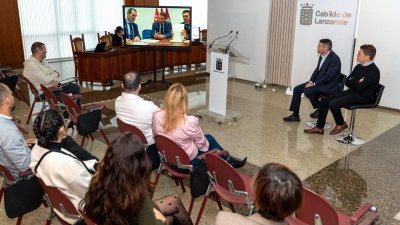
Lanzarote defines its participation in FITUR with a very positive balance, highlighting an intense agenda during the fair, which featured rigorous planning and the formalization of strategic agreements that reinforce the island's tourism model.
"The fair has once again been the starting point of the year and a key space to accelerate projects, consolidate alliances, and demonstrate, with facts, the roadmap guiding the destination's tourism promotion," declares the President of the Cabildo, Oswaldo Betancort.
Throughout the four days of the fair, Lanzarote held nearly 70 working meetings with airlines, institutions, operators, and strategic entities. "A broad and diverse agenda that is not a matter of chance, but rather a plan aligned with the destination's objectives and aimed at identifying the interlocutors capable of driving and accelerating the strategic lines on which the island has been working," considers the CEO of SPEL-Turismo Lanzarote, Héctor Fernández.
The island's participation in FITUR has also served to "raise awareness of a clear commitment to an experiential, diverse destination with its own identity." The presentation of projects linked to gastronomy, culture, music, sports, and innovation is not a response to isolated actions, but rather to an integrated vision that seeks to generate differentiating experiences and, with them, a greater impact on tourist spending and the local economy.
Likewise, the celebration and presentation of initiatives such as the iBLUE Congress within the context of FITUR respond to a clear positioning strategy. "Innovation and the blue economy are consolidating as key vectors for the future competitiveness of the destination, taking advantage of the fair's media impact to project Lanzarote as a territory that leads the debate on new tourism models," stated the Cabildo.
During the press conference held this Wednesday morning at the Cabildo, Oswaldo Betancort highlighted "the enormous work behind each agreement and project presented at FITUR. It's not just about signing documents, but about months of effort, coordination, and commitment from a technical and professional team that has once again demonstrated its ability to place Lanzarote in a leadership position".
Héctor Fernández, for his part, emphasized that "the true value of FITUR is not in direct sales, but in the meetings, the agreements, and the coherence of a strategy that is deployed in an orderly manner. Each meeting, each agreement, and each presentation responds to a defined work plan, aimed at seeking allies that allow us to move faster and be more effective in promoting the destination."Fernández also highlighted the technical, legal, and communication work that makes it possible for agreements to reach FITUR on time, emphasizing that "behind every signature there is a real commitment, with legal and strategic implications, which reflects the seriousness and maturity of Lanzarote's tourism model."
Beyond the fair format, FITUR has once again demonstrated its value as a great space for networking and generating opportunities. A global meeting point where Lanzarote has been able to formalize agreements and commitments with entities such as airlines, destinations, and public bodies, evidencing a strategy based on cooperation, specialization, and effectiveness in promotional action.
In this regard, Lanzarote took advantage of the international platform that FITUR represents to **continue with the key milestones of its tourism roadmap**, among which stand out the Sustainable Tourism Charter +30, reaffirming its commitment to the 11 principles that comprise it and to a model aligned with sustainability and responsible governance, and the presentation of a balance of the 2025 tourism year in which qualitative indicators – quality, spending, and positioning – have taken precedence over quantitative growth
Also, the impetus for market diversification, reinforcing its strategy in the United States and Canada through the signing of agreements aimed at this objective, such as those signed with Turismo Madrid and Iberia; the initiation of a joint line of work with UN Tourism, focused on the decarbonization of the destination and the implementation of the island's Climate Action Plan; the presentation of the second edition of the iBLUE Congress, as a tool to consolidate innovation and the blue economy as strategic axes of competitiveness; and, in terms of connectivity, the announcement with Binter of the new route to Santander, a commitment to qualifying the visitor that also represents this airline's first direct connection to the Peninsula from a non-capital island.

Add La Voz de Lanzarote as a preferred Google source.
Stay informed with the latest current news.