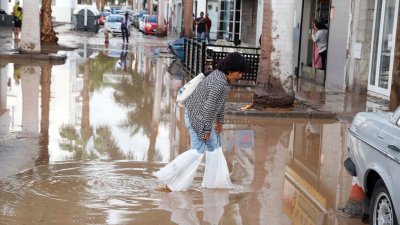
The Cabildo of Lanzarote has activated, on this Wednesday, the Island Emergency Plan of Lanzarote (PEIN) due to the alert for adverse meteorological phenomena declared in the Canary Islands, which will affect Lanzarote with heavy rains, possible storms with hail.
The measure, in line with the Specific Emergency Plan of the Canary Islands for Risks of Adverse Meteorological Phenomena (PEFMA), has as its main purpose to safeguard the safety of citizens. The rain alert situation will begin at 00:00 hours this Wednesday.
Storm Oliver will generate instability, bring cloudiness and precipitation to all the islands. Weak, moderate, strong and persistent precipitation is expected. Heavy and very heavy showers are likely to reach and exceed 15-30mm in 1 hour and 40-80mm in 12 hours and will be accompanied by thunderstorms with electrical activity.
In addition, a pre-alert for possible flooding has also been decreed throughout the Autonomous Community, so it is necessary for municipalities to control the usual black spots, susceptible to suffering specific flooding.
By virtue of this resolution, the alert provided for in the PEIN is activated in the islands of Lanzarote and La Graciosa. Likewise, following the recommendations of the General Directorate of Emergencies of the Government of the Canary Islands, the Security and Emergency Consortium recommends the suspension of recreational, sports, educational and cultural activities outdoors while the alert is in force.
The Cabildo of Lanzarote calls on the population to stay informed through official channels and follow the instructions of the competent authorities.
Recommendations to the population in the face of the rain alert
Before the arrival of the rain, check the condition of the roofs, drains, etc.
If you live near a ravine, inform your City Council if it is saturated with waste, debris, etc.
Before the imminent arrival of heavy rains, pay attention to the instructions given through the media.
Never (even in summer), camp in floodable places: ravine beds, etc.
If possible, stay in your home, bearing in mind that it is not located in ravine beds or in places of risk.
Avoid driving during heavy rains, if it is essential, take extreme precautions, paying special attention to the height of the water, moderating the speed and watching the brakes. If the vehicle starts to fill with water, it is better to abandon it.
Drive preferably on main roads or highways, avoiding forest tracks or secondary roads and using the shortest gears.
In case of having to cross flooded areas where the water has current, tie a rope to your waist, fastened at the other end to some fixed or heavy object.
Do not cross bridges that the water overflows above.
If the problem surprises you at home, prevent toxic and/or flammable substances from coming into contact with water.
Do not enter the floodable areas of the house, such as garages, basements, etc.
Never use the elevator, the electrical fluid may fail at any time.
Disconnect the electrical current.
If the case arises, do not hesitate to leave the house, heading to a higher place, or to where the authorities are referring the neighbors.
If the water isolates you in the upper part of your house, do not abandon it swimming, the current can drag you, it is preferable to wait for help.
Do not overestimate your possibilities, be prudent, and if necessary, wait for specialized help.
Once the emergency is over, do not return to your home until the technicians indicate that it is safe to do so.
Once you can access the homes, do not light matches or devices that give off any spark, including the light switch.
Drink only bottled water.
Call 1-1-2 exclusively in case of emergency. If you need any type of information, use 012 and not 1-1-2.
Recommendations to the municipalities
Plan the signage of the areas that usually suffer damage in the municipality (premises, low parking areas, promenades, etc.).
Control areas of possible landslides.
Inform and alert municipal officials and members of the municipal organization.
Be attentive to meteorological information and, especially, to the warnings issued from the CECOES 1-1-2. Establish surveillance and information mechanisms on the situation
Determine Surveillance Points with the following functions:
- Sign or mark the floodable areas of the municipality: avoid parking vehicles, make sure that activities that may be affected are not carried out.
- Make a forecast of the available and necessary resources.
- Establish the corresponding notices to the emergency services, the basic services and the entities
Communicate the activation of the municipal plan to CECOES 1-1-2.
Use the TETRA RESCAN network as the main radio communications system with CECOES 1-1-2
Control access to promenades, breakwaters and dikes.
Evacuate the beaches if necessary and prevent bathing in the sea and prohibit sports and recreational activities in the sea.
In a situation of imminent risk, cut off the traffic of those roads or paths that lead to the floodable areas (traffic control). Especially signal and cut the fords.
Notify the population that is in the areas where the evaluation of the situation makes it foreseeable that damage will occur.
Evaluate the constitution of the CECOPAL and the management and advisory bodies of the PEMU.



Add La Voz de Lanzarote as a preferred Google source.
Stay informed with the latest current news.