
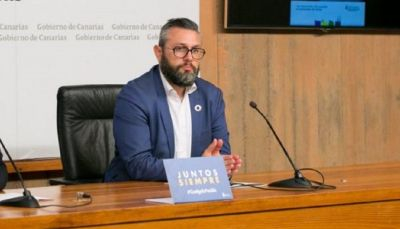
The island's most emblematic beaches and some of its infrastructures could suffer the ravages of climate change before the end of this century. This is reflected in a report recently presented by the Government of the Canary Islands, which places a total of 9 points in Lanzarote and one in La Graciosa at "high risk". The Deputy Minister for the Fight against Climate Change of the Regional Executive, Miguel Ángel Pérez, explains the specific risks facing the island.
The report paints a worrying scenario throughout the Canary Islands, but particularly in Lanzarote. What possible consequences are we talking about exactly? Could beaches like Famara disappear?
Lanzarote and Fuerteventura are the easternmost islands of the archipelago and the oldest, and therefore those that have suffered a more pronounced erosion process. The beaches of Lanzarote, especially Famara, due to its biological richness, is perhaps the area that may suffer greater environmental damage, without forgetting other types of areas that would also be affected. If we do nothing from the public administrations and from society in general, if we do not adapt to future climate change, that is the reality that can occur in Famara and in others.
But would we be talking about a total loss of what we know today in those points of the coast?
Yes, yes. Obviously the sea level would rise enough so that the beach we know today would be completely different.
In addition to beaches, the report also places infrastructures, such as the desalination plants and the Las Caletas power plant, in the spotlight.
The reality is that the project talks about the rise in sea level, and how it can affect the territorial area and the infrastructures associated with the coast. Not only energy infrastructures or roads that also pass through the area, but also important areas of coastal population in the Canary Islands. Almost 80% of the population in the Canary Islands lives from 0 to 500 meters of altitude, and therefore would be affected in some way if that level becomes a reality and if the erosion, which continues to increase day by day, is concentrated in those areas, which is where the greatest economic production in the Canary Islands is due to tourism.
And we are not talking about such a distant horizon, are we? Because the study's projection is of the effects between 2050 and 2100.
Our children and grandchildren will see the effects. I repeat, if we do nothing, they will see the important loss of enclaves that today would be unimaginable to lose. Not only because of the high protection, but also tourist areas such as Las Teresitas in Tenerife, or the Adeje and Arona area, or the Puerto del Carmen area, which would be affected by the rise in sea level. We would be talking about 0.60, 0.30 or 0.90 meters of level rise that would absolutely collapse the economic system we live in in the archipelago.
Within the high risk level, the report gives different scores to each of the most affected areas of the island. What does each one imply?
Five measures have been put in place, from slight risk to extreme risk. Puerto del Carmen is about to be at extreme risk, due to the uniqueness of the area. There are others that are at "very high", such as Famara or Flamingo, which has a fairly high risk. There are other areas that are not named but do have a high risk, such as Playa Blanca, although it is not in the document itself.
A weighting has been made based on strictly scientific criteria, where population, infrastructure, heritage, habitat and ecosystem have been weighted. And from there comes a risk value. In Famara the risk to the population is not high, obviously, but in the ecosystem it is very, very high. In Puerto del Carmen, however, there is a greater problem due to the population issue, due to the very strong floating and tourist population. The coastal area could be affected by the rise in the sea and have a high problem.
Therefore, we should be thinking about what the future model of tourism development in the area is and the great transformation that has to be done in Puerto del Carmen so that we can continue to enjoy Puerto del Carmen, but with a different mentality than we currently know.
And how would that "transformation" be done?
That great sandy area of Puerto del Carmen will be affected by the rise in sea level. Therefore, it will cause many of the beachfront homes to be affected. But I insist, all this is if we do absolutely nothing. Let's be optimistic and believe that public administrations and citizens will do everything in their power so that we can continue to enjoy Puerto del Carmen, Famara and the rest of the hot spots.
The final report gives a picture that can cause nervousness to many people, but it is real and crude as what is affecting the planet, which is the non-negotiable rise of two degrees in temperature. This will not only cause the sea level to rise but also cause important habitats for the Canary archipelago to be lost. Therefore, everything possible must be done to avoid these disastrous consequences.
Apart from this global fight against climate change, when presenting the report they talked about carrying out detailed studies in each risk area of the Canary Islands to try to take measures in each point. What can really be done?
There are adaptation measures, such as what we are doing in Garachico, Tenerife. There is a European Union project, called Life Garachico, in which we are investing 3.5 million, apart from one of 6 million more to readjust the entire coastline of the important high tides that Garachico suffers. It is well known how dangerous they are, and therefore the redefinition of that coastal space involves territorial planning, the implementation of prevention measures and, above all, the adaptation of urban elements in the affected areas, the protection areas in the beach areas, where submerged dikes and especially in the new urban structure, ceasing to build in areas that we will know in the future will be flooded by the rise in sea level.
But it would be a titanic task to transfer that to the 80 points in the Canary Islands that the report places at high risk, wouldn't it? Is it viable, considering that the deadline is a few decades?
Yes, we have decades left. Hence the importance of having the entire strategy that the Government of the Canary Islands is carrying out, because it is not a deception. We have been saying it since 2019. It was declared a climate emergency by the Parliament of the Canary Islands in January 2020, and with the approval of all political forces to do everything possible to ensure that the effects of climate change are as minor as possible.
Now there is a lack of many resources and a lot of awareness, we know where to go, we must adapt as best as possible and lose the least biodiversity and the least impact on the people who live in the Canary Islands.
However, with climate change there are still deniers.
Yes, although fortunately, for now in the Canary Islands the radical extreme right-wing parties, which deny climate change, have not entered. For that part, all the political parties represented in Parliament, as well as the Canarian society, have an awareness that we are playing it and something must be done, do a lot to avoid the problem we are facing now.
We started very well, in the first decade of the 21st century, creating an infrastructure of the Commissioner for Climate Change, but it disappeared with the crisis and with the Government of 2011. Now we have taken it up again with the declaration of climate emergency, with that future Climate Change Law, the decarbonization strategies, the just transition so important.
We are doing everything possible to readjust the times and that with the Sustainable Development objectives in the Canary Islands, we have alternatives to the still picture of this project.
A few days ago they also presented a report on the carbon footprint of the islands and Lanzarote again did not fare well, among other things due to the low penetration of renewable energies in both this island and Fuerteventura. What is failing?
It is a reality that exists, it is the great problem of penetration in the Canary Islands, despite the fact that we have increased almost 10 points compared to 2019. We are in seven islands where 5 of them are biosphere reserves, and therefore a planning must be done for the penetration of renewable energies.
It is better to do them well, in agreement with the Cabildo, than to be imposing in the territory a penetration of renewables that today is not feasible to absorb all with respect to the fossil energy regeneration plant that is on the island. Therefore, over time the data will improve and I have no doubt that in four years the data in Lanzarote will improve a lot. There is the Canary Islands Energy Transition Plan working, which is in strategic environmental assessment, so by the end of the year we will have that document in which Lanzarote and Fuerteventura will see which are the most suitable areas for wind and photovoltaic energy. In addition to offshore wind, which will also play a very important role in the archipelago.


