
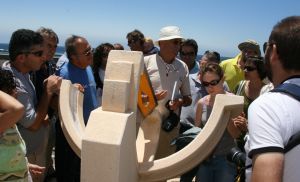
Because of the Fire Mountains, the unbeatable climate, the idyllic beaches or the footprint of César Manrique. For all these reasons, the island of Lanzarote could be unique in the world. However, there is another curious reason that many people are unaware of and that makes the island of volcanoes a world reference: its analemmatic sundial.
Created more than ten years ago, in 1996, by Juan Vicente Pérez Ortiz, this clock is the first of its kind in the world that, on the one hand, shows solar time, and on the other, mean time. In addition, it also indicates the day and month in which we find ourselves. Throughout Spain there are currently about twenty clones, distributed in exceptional places such as the University of Santander, in La Laguna, in Tenerife or in the Port of Alicante, but the one in Arrecife, located in the Castle of San Gabriel, was the first.
Apparently simple (it measures no more than one meter and is made up of two rings), its strict precision is surprising, "of one minute", which means that the shadow projected by the sun on its surface advances constantly, "minute by minute". However, its main utility is not to tell the time. "This sundial is not for telling the time but for learning astronomy", explains its creator. In fact, as is natural, at night, it stops, "but during the day it has power forever", says Juan Vicente. Thanks to this instrument, visitors can learn numerous astronomical concepts such as "how the Earth moves, how the Sun moves or why the star king rises in summer and falls in winter".
"Analemmatic"
The scientific name of Juan Vicente Pérez Ortiz's creation is "analemmatic sundial". But what does analemmatic mean? "Analema is an equation that corrects the difference between solar time and mean time (which is what we are governed by)", explains Juan Vicente. If we were guided by the Sun, there would be a different time in each point of the world, even within the Canary archipelago itself. This is because of the different geographical locations and, above all, the inclination of the Earth's axis. To avoid this time disparity, astronomers invented mean time, which, according to the meridians, divides space into time zones.
"The difference that exists between mean time and solar time is defined by an equation, which is a curve, and is called analema", explains Juan Vicente. "If we place that curve on the back of the sundial, it corrects the solar time and gives us the mean time", adds the astronomer. Right now, there are analemmatic clocks that have the analema drawn on the surface of the hours. However, the invention of the astronomer from Alicante "carries it on its back".
"Scientifically, it is the best and artistically, a jewel", emphasizes Francisco González de Posada, president of the Academy of Sciences and Engineering of Lanzarote and responsible for Juan Vicente Pérez Ortiz deciding to present his invention here. "This clock establishes a dialogue with people, explaining to them, for example, where the Big Dipper is located", he says.
Creative vein
Like any artist before his works, Juan Vicente Pérez Ortiz feels "a very great pride" when he comes to Arrecife and contemplates his clock. However, the fact that the Castle is now an exhibition hall and visitors are not allowed to observe the clock, conveys a certain sadness to him. "It's as if I were exhibiting in a museum that is closed", he laments.
Passionate about astronomy, his acquaintances say that "he makes a sundial with a simple CD". But the astronomer's inventive vein does not end here. He has also designed a mobile astronomical observatory, a truck that carries a telescope and a dome with which you can observe the firmament "from anywhere". The original vehicle has traveled throughout Spain and with it, Juan Vicente has taught astronomy courses.
This is how the invention was conceived
Born in Alicante, Juan Vicente Pérez Ortiz affirms emphatically that astronomy is his "great hobby". It is such a strong hobby that, back in the 70s, while he was working in a savings bank, his directors realized his enormous potential and put him in charge of an astronomical observatory, which he himself created. The idea of the sundial arose naturally. When Professor Francisco González de Posada met him in Alicante "he told me that he was going to set up a divulgative observatory in the Castle of San Gabriel and that he would like me to design something".
At that time, he was working on the sundial and decided that Arrecife was the ideal setting for its premiere. From 1996 to 2004, Lanzarote became a glorious setting for scientific-astronomical activity. However, "at the end of 2004, the Cabildo decided to close the Blas Cabrera Cultural Center (promoter of this great cultural activity) and truncated this good time", laments González de Posada. The Academy of Sciences and Engineering of Lanzarote, which he chairs, is trying to promote this "glorious era" again.


