
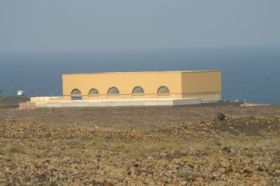
An award from the Arbitration Court of the Chamber of Commerce of Las Palmas obliges Inalsa to pay 9,381,761 euros to the UTE that built the new Janubio desalination plant, as damages, because it understands that the public water company did not pay for the execution of these works.
The technicians and legal advisors of Inalsa and the Cabildo are studying the possibility of appealing said award, as reported this Monday by the CEO Mario Pérez, after notification of said award was received on the 16th. However, the possibility of said appeal succeeding is presented as complicated, according to judicial sources consulted by La Voz, due to the great weight given to arbitration awards. The appeal should be filed with the Civil Court of Arrecife of First Instance, within a maximum period of two months, but it cannot rule on the merits of the matter, on which the award can be considered final, but on the possible breach of certain rights, such as the right to legitimate defense. Defenselessness has been one of the arguments already raised by Inalsa before the Arbitration Court, but it has rejected it.
In the pronouncement of the Court, very forceful, it is pointed out that Inalsa incurred in a "serious breach" of the contract it signed with the firm in charge of executing the works, the Temporary Union of Companies (UTE) Edam Janubio, belonging to FCC Construcción SA. The award also highlights that Inalsa made an "unjust enrichment" due to said breach, which in turn is considered "conscious and deliberate". The Court also affirms that the Island Water Council acted with a "belligerent tone" and "discredit" towards the UTE "and against Inalsa itself".
The form of payment established in the contract was through the exploitation by the UTE of that desalination plant for fifteen years, charging for the water it produced during that period, but that plant, as of today, is not in operation. The UTE assures that it is because the Island Water Council has not given the corresponding authorization for said exploitation, and that according to the contract, if the execution is delayed due to lack of any authorization, the execution period will be extended, without a fixed date.
However, Inalsa points out that one thing is the authorizations, and another very different is the concession of the service, intermingling at this point the competences of the aforementioned Inalsa and the Water Council, although they are really independent bodies with different composition. The latter (the Council) had in turn issued a decree, after the contract, repealing the exploitation of the desalination plant by the UTE. However, the arbitration award considers both organisms as one for the purposes of this case, and does not accept the differences between "authorization" and "concession", giving the reason to the private company that filed the lawsuit.
Said lawsuit against Inalsa was filed in the Arbitration Court on February 13, but the beginning of the case dates back to almost five years ago. On June 7, 2001, the public water company published the call for a public tender to provide the south of the island with a seawater desalination station, awarding the contract to the aforementioned firm three months later. This contract was signed by Enrique Pérez Parrilla as president of the Cabildo and Plácida Guerra as the highest responsible for Inalsa. It established that the construction company could exploit the sale of desalinated water for fifteen years as part of the payment for the execution of these works.
The works were delayed due to the processing of the necessary permits, both due to the type of tasks to be carried out and the qualification of the land, especially protected, according to the award, until "finally, the need for water made the plaintiff and defendant (the UTE and Inalsa) reach an agreement to execute the works in a situation of legal precariousness, notwithstanding which they finished, lacking the installation of the technical desalination equipment".
On the part of the Cabildo it is argued that the UTE must conclude the works and comply with the contract, that is, produce water, but from the aforementioned private company they maintain that they have not been given the administrative permits to continue executing the project, specifically, to be able to carry out said production. Faced with this, the UTE desists from claiming that said contract be fulfilled, despite the fact that it had already done so through the contentious-administrative judicial route, and presents an appeal before the Arbitration Court of the Chamber of Commerce so that it be compensated for the work done so far.
Said Court now comes to give the reason to the UTE, under the main argument that the agreement between both parties indicates that Inalsa will be the responsible for obtaining all the necessary authorizations and permits referring to the desalination plant project and to the execution and exploitation of the same. Therefore, the Arbitration Court did not admit the allegation of the Island Water Council about that the UTE "had breached, because it had not provided itself with the necessary licenses".
The pronouncement of said Court indicates that the resolution of the Island Water Council is of "belligerent tone", as well as the "discredit with which it is dispatched against the UTE Edam Janubio and against Inalsa itself, even referring to the latter as an incapable person", which "shows that the matter exceeded the private regime to be considered a political issue, and certainly the attitude of the Island Water Council constitutes a perfect example of the development of an activity dilated in time, perfectly consciously and deliberately assumed to prevent the execution of the contract that binds the parties".
In turn, the award affirms that the Arbitration Court "was able to verify in situ that the work was fully finished and that it only remains to install the technical furniture, which in its communication of January 18, 2005, the UTE Edam Janubio urged to choose Inalsa, without obtaining a response".
Thus, the award considers that Inalsa has subsumed the payment of the works "in a figure that was illegal at the time of carrying out the verification act of the staking, as was the faculty delegated to Inalsa to authorize the exploitation to the UTE, since such provision had been repealed by means of the decree of the Island Water Council" already mentioned.
Therefore, the Arbitration Court considers that "the only possibility of legally settling the payment was -and is- the lump sum payment, in currency, since no other legal possibility exists", so it establishes that Inalsa must pay the UTE the almost 10 million euros demanded.
Danger of bankruptcy
"For us this constitutes not only a surprising award, but also unfair. This is not only an Inalsa issue, but an insular issue, of the Cabildo and of the seven City Councils, and an absolutely strategic issue, since the continuity of a company like Inalsa is questioned, because facing a payment of ten million euros could mean its bankruptcy, although for the moment we want to be prudent", said to La Voz the current CEO of the public company, Mario Pérez.
"The UTE has not charged because it has not finished complying with its obligation, since to charge it must produce water and sell it to Inalsa, and it is not doing so, since the plant is not in operation", added Pérez, while pointing out that it is "surprising that the Chamber of Commerce decides on these disagreements and not a court".
Faced with this, meetings of the Board of Directors of Inalsa and the Island Water Commission have been convened, which will meet next Thursday and in which the legal report on the possibility of appealing the award that the technicians and legal advisors of Inalsa and the Cabildo are preparing will be announced.


