
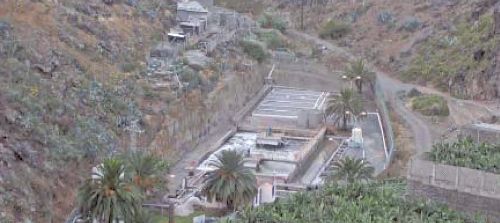
A new temporary joint venture (UTE), formed by the Ferrovial group and the Canarian company Santana Cazorla, is carrying out a large hydraulic project in Gran Canaria, which promotes the use of water and the care of the environment. The works consist of the construction of two wastewater treatment plants (WWTP) in Tamaraceite and Tenoya, as well as two water tanks, one in the San Lázaro cemetery, in Las Palmas, and another in Guanarteme. These infrastructures will greatly increase the water treatment capacity in this area of the Canary Islands. The project has an investment that reaches 15,107,000 euros.
Specifically, this UTE is made up of the construction company Ferrovial Agroman and Cadagua, both from the same group, and also has its regional partner, Hermanos Santana Cazorla. The site manager of the UTE, Osvaldo Angulo, explains that the union of these companies arose months before they submitted to the public tender, carried out by the General Directorate of Water, of the Ministry of Public Works and Transport of the Government of the Canary Islands.
The UTE, which was awarded these works in August 2010, has already begun to work to launch these large-scale projects for the island of Gran Canaria. For the moment, it has already emptied the Tamaraceite treatment plant, which, like the Tenoya plant, was still in operation, but had become quite outdated and scarce. "They were working precariously, with a lower performance than they will have from now on. The daily water flow for purification will be greatly increased. A project is being carried out with a view to 20 or 25 years", indicates Osvaldo Angulo.
And this is because this "Basic Project of the Tamaraceite and Tenoya Wastewater Treatment Plants" aims to modernize these facilities, which began operating in 1984 and 1981, respectively. As explained by the site manager of the UTE, "in addition to the natural deterioration of the facilities due to the time elapsed since their construction, there has been a significant increase in the number of inhabitants in the areas that discharge into both treatment plants." "In the current situation, the raw water flows are much higher than their treatment capacities," he says.
Works until 2013
Therefore, what this UTE will do is demolish the old treatment plants and build new infrastructures on this space, on land that has approximately 3,000 square meters. "The works begin now, in January, and will last until 2013. They will consist of collecting water from homes, sanitizing it, treating it and purifying it to later transform it and be able to give it other uses," says Osvaldo Angulo, who also emphasizes that this water will be used for irrigation of agricultural fields, as well as a golf course that is planned to be built in the Guanarteme area.
In addition, in the case of the Tamaraceite treatment plant, the new infrastructure, which will be "much more modern than the one that exists now", will prevent the bad odors that, from time to time, emanated from this space. "Membranes are used through which almost potable water is obtained," says the site manager of the UTE.
Hiring of personnel
These projects will also involve the hiring of a large number of personnel, at a particularly sensitive time for the Canary Islands, which, unfortunately, has a very high unemployment rate. "The UTE's construction team will be made up of approximately seven or eight people. In addition, there will be around 70 or 100 people who will have to work at a specific time during the work. These will last until April 2013, so for more than two years they will employ many people," Angulo defends.
"The Canary Islands needs this type of investment at a very difficult time in which there is a lot of unemployment. The Canary Islands needs this type of public works," Angulo indicates.
Osvaldo Angulo feels "proud" to be able to participate in these projects. "They are new works for mé. I have done the Fuerteventura airport, which was a very large work commissioned by the Ministry of Development and Aena. I am a civil engineer and, in the end, this is my thing. I am happy," says the site manager of this UTE.
A prestigious UTE
The UTE that will have to carry out these works has great international prestige. First of all, Ferrovial has become the largest private manager of transport infrastructure in the world and a leading provider of services. It is one of the most international Spanish firms, with a presence in 49 countries, a workforce of 107,000 people and assets of 48,200 million euros.
In addition, it has activity in complementary sectors such as construction, operation of airports and highways and services.
The company Cadagua, which belongs to the Ferrovial group, also has 40 years of experience and is recognized as the pioneering and leading national company in the market for engineering and construction of water treatment and purification plants.
For its part, the construction company Hermanos Santana Cazorla was born in the 70s in Gran Canaria and currently has a group of very successful companies.
RELATED NEWS
["The Canary Islands have a water shortage and it must be taken advantage of"->48655]


