
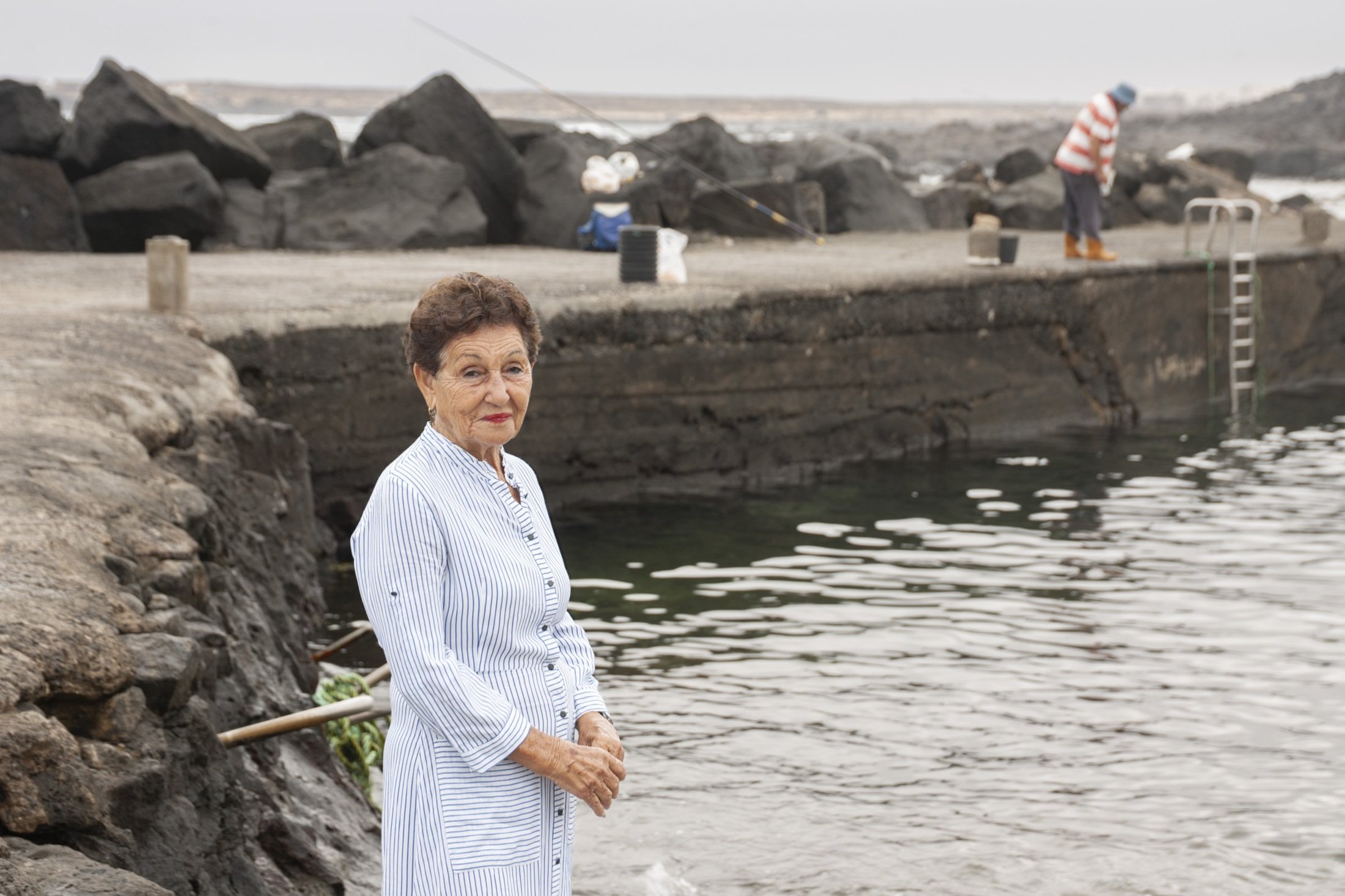
Between scales and guts of croakers and sardines. This is how Rosaura Martín Olivero (La Santa, 1945) grew up, who worked from the age of eleven as a cannery worker in all the fish factories forced by the misery of the time and the need to earn some money to help her parents and feed her eleven siblings.
In an interview with La Voz, Martín recalls a childhood in which "we went through quite a bit of hardship." Because of this, out of necessity, she had to start working as a cannery worker without having gone to school. Only her six younger siblings were able to study in a Lanzarote where going to class became a privilege because, before that, one had to try to get something to eat.
"I remember that we didn't even have anything to eat, my father went to sea and caught fish... my mother prepared it and fed us," she says. "I remember my father got sick, he had to go to Gran Canaria and my mother had to ask from house to house in Tinajo to be able to feed her children," she recounts.
Rosaura Martín began working as a child in the old factory Lloret y Linares S.A., founded in 1957 on Carretera de los Mármoles, in Arrecife. "I worked there for a couple of years and then I went to the cannery," she recalls. Later, and after marrying her husband at the age of 22, she continued working at the Garavilla cannery, which was located near Valterra.
Years later, after giving birth to her last child, the Lanzaroteña moved to the Rocar cannery, in Islote del Francés. During her working period in the canneries, Martín even worked while pregnant after getting married and, after giving birth, her mother would take care of him.
Work in the canneries
Despite her young age, Rosaura Martín entered the labor market in the first cannery, Lloret y Linares. "The men salted the fish and we women washed it," but she admits that "I was not old enough to work." In the rest of the factories, and after getting married, she packed sardine cans.
Women of all ages worked in the canneries, but Martín remembers that they didn't want to hire her due to her young age. "They didn't want to admit me because they said I was too small, but I saw that a cousin of mine working there was the same age as me and I told them that if they didn't hire me, then they had to fire my cousin because I wasn't going to leave," she says, laughing.
And the woman from Lanzarote did not leave there, but stayed fighting to be able to have a job to support her family despite being forced to mature and grow up before her time.
The cannery worker recalls that the work with croakers "was a bit heavy," while the work with sardines was more dynamic. "We cut off their tails and put them in the can," she indicates. In fact, during this interview Rosaura shows the after-effects of working in the factories at such a young age: a scar on one of her fingers that she got while pushing one of the cans into the machine.
After drying the fish, in this case croakers, they were packed in bales in the so-called 'enfardados', the areas dedicated to packaging for distribution outside of Lanzarote.
Uninsured workers and low wages, the reality of the time
The working days were hard, especially for a child. Martín recounts that the cannery women worked eight hours a day and slept in facilities that are now in ruins in Los Mármoles. "A truck from the factory in Lloret used to come to pick us up at dawn from La Santa to take us to Arrecife to work," she says, emphasizing "the hardships we went through."
In the cannery factories, Rosaura Martín says that she did not have a good salary. "I don't remember how much they paid in pesetas, I think it was 18 pesetas, we earned almost nothing," she laments. Today, this salary would be eleven euro cents.
And it is that, in addition to the low wages, many of the workers were not registered with Social Security. "I think half of us were not insured," she assures. And it is that, according to the cannery worker, the reasons could be her young age and also the company's decision not to register them. "At that time, there weren't many inspectors, but when one came, I would hide in the bale packing area because I wasn't old enough," she recalls. In fact, Martín was not registered for the entire time she worked in the factories.
Despite the poor working conditions, the work in the canneries and the little money she earned provided a boost for Rosaura and her family. "It helped me because I could help my parents get ahead, but not just me, my sisters too because they worked in the canneries," she points out.
Although it was a tough stage, the Lanzaroteña acknowledges that that time also left her with good memories. "I had a good time working there even though I was a child, I got along well with my colleagues and I have many friends who worked with me," she says.
A happy life despite everything
One of the things Rosaura Martín regrets most is not being able to have gone to school, as only the first six children were able to study. "What they know is what the boys learned when they went to the barracks and the three sisters knew nothing," she says. "I would have liked to go to school, but they couldn't," she continues. Furthermore, in Lanzarote in the mid-20th century, the Lanzaroteña remembers that they had to walk from La Santa to school.
Currently, she acknowledges that "life has changed a lot because before one was very alone" and highlights the hardships they had to go through to survive.
However, Rosaura looks back in time and admits that, despite everything, she has had a life full of good things. "I have been very happy, from when I got married until today. I was widowed fifteen years ago, but I have been happy all my life," she concludes.
Rosaura Martín belongs to a generation of Canarian women who fought against all odds for their families and to achieve a better future for them. Her strength, determination, and affection are the mirror in which our mothers and grandmothers are reflected, who gave everything even when they had nothing.
Add La Voz de Lanzarote as a preferred Google source.
Stay informed with the latest current news.


