
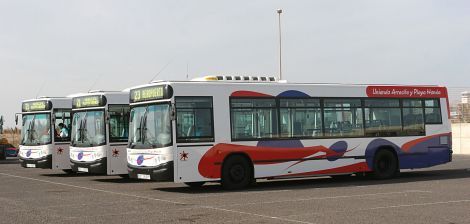
The new Arrecife-Playa Honda circular line has been in operation since Wednesday morning, for which two buses have been allocated with an estimated regularity of about 30 minutes.
The two new units, which will connect Arrecife with Playa Honda (line 21) and the island's capital with Guacimeta airport (line 22), operate from seven in the morning to ten at night from Monday to Friday; and from eight in the morning to ten at night during the weekends.
The project, which has been talked about for almost a year and a half, is part of the Department of Transportation of the City Council of San Bartolomé and Arrecife, and the Cabildo of Lanzarote itself. It is endowed with 600,000 euros, an investment that has also served to repair sidewalks and the placement of new bus shelters.
Among the novelties of the two new units, ramps have been enabled for the access of the disabled and a great color to vary the traditional image of the buses that cover the intercity transport service.
The routes of both lines pass through other points of both Arrecife and Playa Honda, such as San Francisco Javier and El Reducto or Calle Mayor and the industrial estate.
Program Contract
The agreements signed between the town councils, the Cabildo and the concessionaire company of this service, Arrecife Bus, usually last between three and five years. Among the public investments destined to regular transport, which is not discretionary, there are amounts for the renewal of the bus fleet, whose average life period is estimated at about seven years.
The Minister of Transport of the Cabildo, Juan Pedro Hernández, remarks that these program contracts are based scrupulously on the demand of each municipality. "Each mayor has told me about the needs of each area and we have materialized them in the last agreement".
In case of irregularities in the service, such as "not complying with schedules, not respecting routes, documentation or weight of the vehicle, the company is sanctioned through the Transport Inspection of the Cabildo".
According to the minister, despite the fact that these sanctions are frequent, the intercity transport, which has traditionally enjoyed a fairly bad reputation on the island, "is improving quite a bit, for example with the placement of schedules and routes at all stops".
Intercity transport in Lanzarote
In Lanzarote there are regular bus lines since 1957. Esther Cabrera, general manager of Arrecife Bus, the private company that manages intercity transport together with the town councils of the seven municipalities and the Cabildo, defends the policy of her company: "The changes are seen very little by little, but the lines that cover transport between the municipalities have a regularity and a frequency that, according to all our studies, exceeds 80% accuracy".
Although from public institutions and from the concessionaire company it is pointed out that the demand for intercity transport in Lanzarote is more than satisfied with the number of buses that circulate daily, even during weekends, the same is not thought from different social sectors.
Deficiencies
There are places that, despite not having true neuralgic centers, do have a large volume of population that must move to the most central or tourist areas. In Tinajo until recently there was only one bus a day to get to El Cuchillo. La Santa did not have this service either, and there are still localities such as Yaiza, Teguise or the Famara area with many connection difficulties.
For many users, most of the buses are outdated, even unions such as CC OO denounce that drivers have to work more hours than stipulated by law.
For her part, Esther Cabrera responds that "it is logical that we base ourselves on the demand of the destinations. Thus, there are more buses where they are most needed. Right now we have 38 buses daily on the street for the intercity service". All of them must have air conditioning and be in an adequate state. In addition, the company must have prepared reserve buses, which are used either for unexpected over-demands in specific points, when there are unforeseen traffic cuts or in case of breakdowns.


