
Aside from the controversy over who was the first to arrive in Lanzarote, whether the Genoese Lancelotto Malocello or the Norman Jean de Bethecourt, the program of presentations and the category of participants in the "Study and debate conference on Lancelotto Malocello" promises to be "most interesting and revealing", according to the Cabildo. The conference will take place this Thursday and Friday, in the assembly hall of the island institution, starting at 10 am.
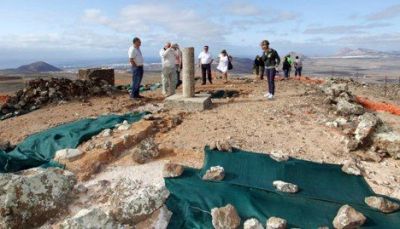
It should be noted that this 2012 marks 700 years since the arrival of the Genoese navigator to the island of Lanzarote. He incorporated it into the knowledge of Europe at the time under the Genoese flag, included it in a maritime cartography, lived there for about twenty years, and ordered the construction of a castle, the remains of which are being searched for and analyzed on Mount Guanapay, in Teguise.
Directed and coordinated by the professor of Prehistory of the University of La Laguna, each and every one of the presentations and interventions is an open door to the knowledge of the past of Lanzarote and an invitation to understand its nature and evolution in many other areas. These conferences are organized by the Department of Education and Culture of the Cabildo and the Government of the Canary Islands, as well as participated by the municipalities of the island, around the events celebrating the 700th anniversary of the arrival of Malocello to Lanzarote, promoted by the jurist and essayist Italian Alfonso Licata.
Speakers of "very high level"
From the director-coordinator of the conference to the most modest of the speakers, all "are worthy of the most devoted admiration". Antonio Tejera Gaspar, who performs this work, in addition to presenting two papers, has "an extensive and very brilliant" academic and professional curriculum.
Tejera is a professor of Archeology at the University of La Laguna. He has written or co-written 37 books on the past of the Canary Islands, its inhabitants and origins of these, ways of life, religious beliefs and burials, social organization, as well as several archaeological letters. He has written the prologue to more than a dozen publications and written and/or participated in almost fifty articles in regional, national and international press.
Doctor in Philosophy and Letters (University of La Laguna), he has been a professor of different subjects of Ancient History and Prehistory, both practical and magisterial. He has also participated in numerous archaeological excavation projects, both in the Canary Islands and in Huelva, Seville and Córdoba. Among the most significant: San Marcial del Rubicón (Yaiza, Lanzarote); Study of the rock carvings of Lanzarote; Underwater Archaeological Investigations in Tenerife and Lanzarote; Archaeological Investigations in Zonzamas (Teguise, Lanzarote); as well as Study of the rock carvings of Fuerteventura. To which must be added a very long list of presentations in courses, seminars, congresses and specialized conferences, doctoral theses and directed degrees.
For his part, Alfonso Licata is president of the Association of Italian Friends of Lanzarote and also chairs the Italian Promotion Committee for the Celebrations of the Seventh Centenary of the Rediscovery of Lanzarote and the Canary Islands by the Italian navigator Lanzarotto Malocello 1312-2012. Licata is a jurist and current Honorary Judge of the Ordinary Court of Rome, his hometown. He is an expert in graphic arts and has written articles on history and geography, as well as a knight of the Order of the Holy Sepulcher of Jerusalem and Malta, and a member of the Lion Club International Roma Parioli.
His compatriot Sandro Pellegrini, is a writer, journalist and member of the Italian Geographical Society. He is the author of several books on the impact of the Genoese in Spain and in the Canary Islands in particular, as well as others on the Genoese navigator and his cartography, respectively: "Lanzzarotto Malocello"; and "Lazzarotto Malocello: the fame of a nautical map".
Elena Sosa Suárez is an expert in the study of imported ceramics (not made in the Canary Islands or aboriginal), a topic on which she is preparing her doctoral thesis. She is in charge of studying the ceramic remains found during the excavations on Mount Guanapay, where it is believed that the remains of the castle of Lancelotto Malocello are located.
Archaeology
María del Cristo González Marrero is a contracted professor doctor at the University of Las Palmas de Gran Canaria, and teaches within the Area of Medieval History. Her first research, with which she obtained the title of Doctorate, revolved around the House of Isabel la Católica. At the same time, she developed a new line of research related to archeology applied to non-prehistoric sites or in which the presence of material findings of import is manifest, from the moment of contact between the natives and the Europeans throughout the 14th to 16th centuries.
She is currently directing a competitive research project, financed by the Government of the Canary Islands, which bears the title: "Archeology of acculturation and colonization. People, objects, animals and European plants in Gran Canaria" (ss. XIV-XVI). Since 1996 she has been part of the research team that develops the international program of Archaeological Investigations in the Sus-Tekna region (Morocco), and in which the ULPGC itself collaborates, among others.
For his part, Dr. Eduardo Aznar Vallejo is the general coordinator of the Center for Medieval and Renaissance Studies; graduated in Geography and History from the University of La Laguna and doctor in History from the University of Seville. In addition to having expanded studies at La Sorbonne (Paris) and Italy. He has been a professor at the universities of Seville and La Laguna, where he currently works, Nice, Paris X, and Lyon II, as well as at the university colleges of Cádiz and La Rábida (Huelva).
He is a member of the Royal Academy of History and a member of various scientific institutions. Specialist in Navigation and Commerce in the Crown of Castile, Colonization and acculturation in the Middle Atlantic and History of the Canary Islands during the Late Middle Ages. He has written books and articles on these and other topics in national and foreign publications (France, Italy, Portugal, United States, Mexico and Morocco). He has an extensive bibliography on the Canary Islands theme and has participated in research projects such as: "Archaeohistorical study of El Rubicón" (Lanzarote); and "An example of the organization of space as a result of the conquest: the birth of the town of San Cristóbal".
Among so many magisterial presentations, it is worth noting as different the explanation of the field work in the presentation of the archaeologists Rita Marrero Romero and Marco A. Moreno Bénitez, of the company Tibicena, Archeology and Heritage SLP. They will present the details and experiences derived from the archaeological intervention in the Guanapay volcano and the Llanos de la Torre, a place whose toponym reveals that there may be remains of the castle of Lancelotto Malocello, the objective of these excavations.


