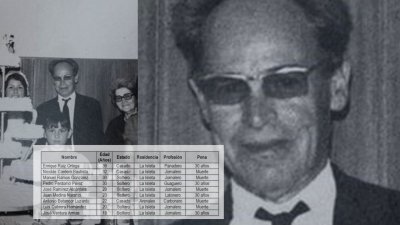
In a tiny room lived locked away for a good part of his life the Lanzarote native Pedro Nolasco Perdomo Pérez (Haría, 1906- Las Palmas de Gran Canaria, 1971). When he entered his hiding place he was a young 30-year-old bus driver and when he left, he was 63, limped, and was sick in the lungs.
For 33 years, he couldn't see the light of day. Perdomo was persecuted by the forces of the Franco regime, but the bravery of his eleven sisters, all born in the north of Lanzarote, helped him survive hidden between walls and holes
The man from Lanzarote was one of those baptized as "moles" of Francoism, those Spaniards who remained hidden in dugouts, rooms, and holes for decades fleeing the repression of the Franco regime to avoid being retaliated against, shot, and ending up dying in a concentration camp, thrown into an empty well, or launched into the Jinámar abyss, as happened to some of the prisoners in Gran Canaria.
"They were looking for my brother because he was left-wing," his sister Antonia Perdomo Pérez recounted in an interview featured in the book *Los Topos* and reproduced by the website *Historia de Haría*.
A Lanzarote native who emigrated to La Isleta
It was 1936, and a part of the Spanish army, led by General Francisco Franco, had initiated a coup d'état against the Government of the Second Republic. The coup led to the bloodiest war the country had ever experienced, the Spanish Civil War, and forty years of dictatorship.
When the war broke out, Nolasco Perdomo and most of his eleven sisters already lived in the La Isleta neighborhood (Las Palmas de Gran Canaria), where, like them, hundreds of people from Lanzarote who were fleeing the hunger and hardships of the time took refuge. He was affiliated with the Socialist Group of Las Palmas de Gran Canaria and had been a member of the Executive Committee.
Just six days after the coup attempt, this man found himself pursued by Francoist forces who accused him of participating in a shootout in which two soldiers died. The confrontation had occurred between three military men who supported the coup and a group of workers who opposed the military uprising. That day Perdomo fled and hid in the home of one of his sisters, who lived in a neighborhood of Las Palmas de Gran Canaria.
A reward of 3,000 pesetas for his whereabouts
Two months after the death of those two soldiers, the man from Lanzarote was convicted by a military tribunal in absentia, and the local press published his photograph along with a reward of 3,000 pesetas for anyone who helped locate him. The military trial held convicted him to life imprisonment along with three other defendants, while another five detainees were shot.
Nolasco Perdomo managed to escape at a very high price: that of his freedom. When he was able to go out on the street 33 years later, he explained the reason that led him to hide: "Fear, nothing but fear".
It was never known if he was really involved in that incident, but the regime's persecution cost him a life of confinement.
A hole in the ground and a hiding place in a barrel
For the first few months, he hid behind a chicken coop at his sister Antonia's house. However, a neighbor saw him and alerted the Francoist forces. Pedro was able to escape thanks to his sister and the neighbors who helped him flee and take refuge for a few days. According to Antonia, he then lived for a few years at the home of another sister, Catalina, who eventually fell ill and died.
When the neighbor reported Pedro, to get the 3,000 pesetas they were asking for his whereabouts, the Civil Guard brought Antonia to the station, who swore to God that her brother had gone to the port of Agaete: "God knows I have sworn falsely because I would not want to see my brother taken away like they took those poor souls to throw them into the abyss!""It was difficult in the early moments, when many thought they might have been the easiest, but then, one got used to it," the rabbit hunter confessed to a local newspaper in the 60s. During those months his sisters were harassed and stoned by Francoist forces who wanted to find the whereabouts of the man from Lanzarote.
After Catalina's death, her sister Manuela took him in at her house in La Isleta. Pedro lived in a small room, but Manuela opened a hole in the lower part of the wall for emergencies and placed a drum inside so her brother could hide if visitors arrived, with an old stove placed in front of the hole. "Like mouse holes, but bigger," explained his sister Antonia. That gap in the wall served as a refuge for Pedro Perdomo when the regime's forces stormed the homes of the eleven sisters in search of Perdomo. After sixteen years, Manuela also died.
Old radio and newspapers
Upon his sister's death, Pedro continued to flee, doing so to another sister's home. At Rafaela's house, also in the La Isleta neighborhood, he remained hidden for seventeen years on Alcorac Street, number 31. "He went into a small room there and spent the rest of his life," recounted Antonia Perdomo, who paid for the food that her sister Rafaela cooked for him, secretly from her children.
The light in the room where he spent a decade and a half was positioned so it couldn't be seen from the street. During the day, he passed the time reading the newspaper and listening to the radio, while on some nights he went out for fresh air, afraid of being seen and ending up arrested or dead.
Rafaela, with whom he had lived for the last sixteen years, could not always afford to buy the daily newspaper, so on occasion she would get old copies, which Pedro would read in his small room and alternate with magazines from the fifties that he reread, over and over again. Sometimes, he even filled out a betting slip in his name.At that time, Perdomo lived off the food his sister brought him in that secret room, homemade remedies, and over-the-counter medicines
The Haría "mole," the second in the country to come to light
"On one occasion I was ill. I thought I was going mad. I lost my memory and didn't know where I was," Perdomo recounted in 1969, as reported by the media of the time. It wasn't until that year that he dared to go out on the street after the Franco regime approved a law that prescribed political responsibilities prior to 1939.
Perdomo had read in the press about the case of the republican mayor of Mijas (Málaga), Manuel Cortés Quero, known as "The Mole of Mijas," who lived for 30 years hidden in a hole in the wall of his home, thanks to his wife, who fed him. Manuel Cortés was the first Spaniard to come to light after political crimes expired, and the Lanzarote native Pedro Perdomo was the second.
Hearing the story of Manuel Cortés Quero not only encouraged Pedro Nolasco Perdomo to abandon clandestinity, but it has also inspired various works such as the film The Endless Trench (2019).
The day he was free
"Without telling my family, very early in the morning, I took a taxi and told the driver to take me to Las Palmas. Upon arriving at the Police Station, in front of the police officer, I could barely speak," explained Perdomo, according to press clippings from the time. Hesitantly, he presented himself to the officers and asked to claim the statute of limitations for his crime. It wasn't until that year that he could walk down the street againDespite the fear that he might be arrested, Perdomo waited at the police station, where he received a provisional identity document and left on the street in tears. Two officers accompanied him back home, while his sister Rafaela cried.
When he managed to regain his freedom, Perdomo walked the streets of the capital for hours, recognizing fragments of the past in a city completely different from the one he remembered. For weeks, his house became a kind of resurrection celebration, where friends and family who had thought him dead celebrated his return to life. Others, however, believed he had fled to France.
This Lanzarote native died three years after leaving those walls. However, he was never able to live peacefully. After the interviews he gave in the first few days, he never wanted to speak again about the incident that led him to flee or about his years in the shadows.
The same year he was released, at 63 years old, he began a new battle, this time to find employment. No one wanted to hire someone who was so close to retirement age. He wanted to repay his sisters for all the money they had invested in keeping him alive. Pedro Perdomo died in 1974, but his jailer, Francisco Franco, did not pass away until November 20, 1975
To prepare part of this report, press clippings from 1969 from the newspapers La Provincia, El Eco de Canarias, and Diario de Las Palmas were taken into account, as well as information from the Pablo Iglesias Foundation and part of the book Los Topos.

Add La Voz de Lanzarote as a preferred Google source.
Stay informed with the latest current news.