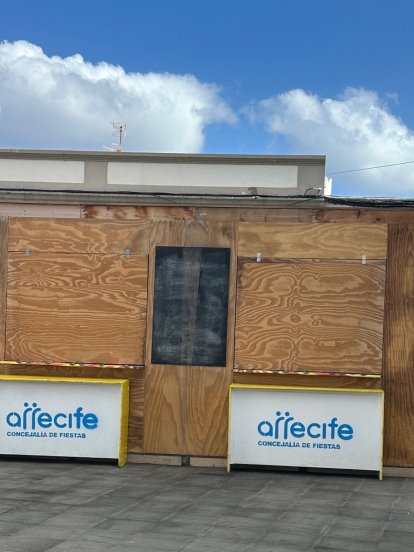
The stallholders participating in the Arrecife carnivals have contacted La Voz to denounce the situation experienced this year **regarding the wooden stalls** and which they consider "unfair, mismanaged, and profoundly detrimental to those of us who bet economically and professionally on being part of these festivities".
According to what they say, in the bases published by the City Council, the obligation to install wooden stalls with specific measurements was established: 6 meters long by 2 meters wide, with the use of metal stalls being prohibited. However, said bases were published "without previously checking if there was real availability on the island of Lanzarote of at least the 26 stalls required".
On February 2nd, the draw for the allocation of stalls was held, and it was communicated that the following day, February 3rd, the stalls should already be set up, warning that, otherwise, the stall would go to the next applicant. In parallel, it was indicated that a waiting list with substitutes ordered by registration would be published on the Town Hall's notice board, something that, they say, "never became public"."As was foreseeable, most of the awardees did not have stalls on such short notice. Lanzarote is a small island and the companies that rent this type of infrastructure are mostly located on capital islands with larger carnivals. Even so, many stallholders made a huge economic and logistical effort to obtain them, with some stalls arriving the day before the carnival and even on the same day as the opening speech. As of the start of the festivities, there were still stalls not set up due to delays in maritime transport, entirely beyond the awardees' control," they stateThe objective that was justified from the City Council was "to achieve uniformity and aesthetics". "The current reality is far from that purpose: the result is a set of completely disparate stalls, with different sizes, different styles, some without homologation and others built in an improvised and hasty manner. Metal stalls have even been installed camouflaged with wooden panels, despite their use being expressly prohibited in the regulations," they assure
On the other hand, they affirm that to all of this "is added an even more serious issue: the total lack of safety measures and minimum conditions for assembly and service provision. At no time was the road closure facilitated for the assemblies. We stallholders have had to bring merchandise, refrigerated units, trucks, and heavy transport onto a highly trafficked road, with a constant presence of tourists and vehicular traffic, assuming an evident risk of accidents that should not fall on individuals".
Likewise, they criticize that the stalls "do not have water or electricity during setup or the hours prior, with the City Council communicating that the supply will only be activated at the start of the event and will be cut off upon its conclusion. This decision is incomprehensible and irresponsible. Refrigerators, freezers, taps, and food preservation systems need hours of prior operation. Without this supply, food products deteriorate, public health is put at risk, and it becomes impossible to offer an adequate service to the public".Despite these shortcomings, "we are required to fulfill all obligations: payment of salary to the Tax Agency, municipal fees, and an approximate cost of 1,500 euros per stall, in addition to the investment in merchandise, personnel, and structure. All of this to find ourselves with an administration that does not fulfill its basic responsibilities nor guarantee minimum conditions to be able to work and properly attend to the citizens and visitors of the island".The general feeling, as they explain, "is one of profound indignation. We have been required to make a considerable economic investment, we have been pressured with impossible deadlines, and, finally, it has been allowed that each person do what they can or want, without control, without sanctions, and without assuming responsibilities on the part of the organizing administration"."We consider this situation deplorable and a lack of respect towards the stallholders, who are an essential part of the atmosphere, the economy, and the life of the Carnivals. We ask that visibility be given to what happened and that, for future editions, action be taken with planning, coherence, security, and respect towards those who sustain these festivals with their work and their money," they conclude.


Add La Voz de Lanzarote as a preferred Google source.
Stay informed with the latest current news.