
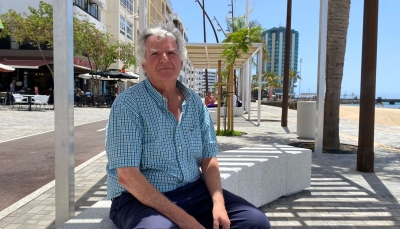
When Leopoldo Díaz arrived as a lawyer at the Cabildo of Lanzarote, the island was immersed in a debate to stop the runaway tourist growth. It was the 90s and the archipelago was experiencing spectacular growth, with the development of thousands of hotel and non-hotel beds on all the islands. Lanzarote was an advanced island that legislated to curb excessive tourism in order to protect its greatest asset: the landscape and the environment, so it proposed a tourist moratorium in its planning plan more than 30 years ago.
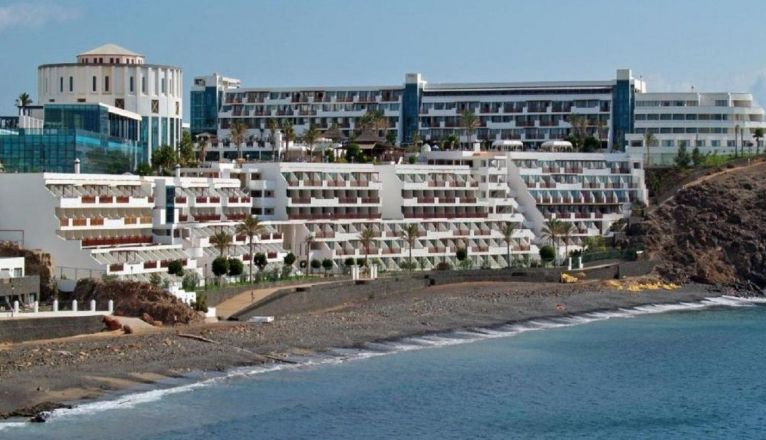
Despite these advances, the Island Plan was not respected and during his first five years as director of the Island Plan Office, Polo Díaz battled against the licenses granted by the Yaiza City Council to build dozens of hotels in Playa Blanca outside the law. "It was never an ideological issue, we never acted on our own. We always did it at the request of the political power," he says during an interview with La Voz.
The past and the future of Lanzarote
In the late 80s, the island's most international artist, César Manrique, was already warning of the need to curb the tourist boom and uncontrolled urban growth, which went hand in hand. The demands that the multidisciplinary artist repeated until his death in 1992, remain more alive than ever in an archipelago tired of mass tourism. "César was very intuitive, very passionate and also very elementary. Elementary in the sense that he had strong, very simple ideas, but that people understood perfectly," says Leopoldo Díaz.
The then island president, Enrique Pérez Parilla, was in charge of "taking up the baton" of Manrique's demands and bringing the start of the new planning document to the plenary session. As a result, in 1990, Díaz entered the Cabildo of Lanzarote as a lawyer for the Island Plan Office, then in 1995 he became its director, a position he held until his retirement a little over a month ago.
"It is a totally innovative plan for that time, for many reasons," defends Díaz. Although more than 30 years have passed, the origin of the Lanzarote Island Planning Plan (PIOL) was "exactly the same as what is being proposed now: we cannot go to a tourist growth that overflows the island's capacity to welcome, that overflows our landscape, that implies a deterioration of our public services, that forces our infrastructures to be adapted."
Therefore, he hopes that the future Island Plan announced by the Cabildo will maintain "the containment framework" that the 91 plan already had and that it will set guidelines on vacation homes. The 91 Plan established "rhythms" and "ceilings" for growth, a "maximum accommodation capacity on the island", which limited how much to grow every four years to avoid exceeding the established limits.
The current one must also tackle the growth in tourist beds, in the most profitable way possible for the institutions. The creators of the 91 PIOL already investigated at length the debates that arise today to establish a tourist tax and the option of using the profits to declassify non-consolidated tourist land or to find legal mechanisms to avoid having to pay millionaire compensations. However, this updated debate will have to take place between the makers of the new Plan.
Tourist licenses outside the law
"When the administration works, it is not only because certain public or political officials champion it, which is also necessary, but because behind them there is a body of serious and hard-working public employees," says the lawyer. In his more than 30 years at the head of the Island Plan Office of the Cabildo of Lanzarote, with some stops along the way, Díaz collected several struggles for the defense of the law. Now, looking back on his years in the administration, he champions the work done.
"I think that with the means we have had, we have complied, with all our mistakes and blunders, we have worked seriously. An Island Plan has been launched in which, beyond the propaganda, so many did not really believe in the background," he says during the interview.
Despite the advances that the Lanzarote Island Planning Plan of 1991 installed, it was not fulfilled in many aspects. "That was one of the great battles of Territorial Policy of the Cabildo," recalls Díaz, after nine years since its approval, "in the year 2000, with Pérez Parrilla as president, the question was raised: Is the Island Plan being applied? No, it was not being applied."
From that moment on, the Cabildo challenged in the Courts those tourist licenses that had been given against the Island Plan. Díaz vindicates the role of the Office in the persecution of these illegal hotel licenses. "Despite the fact that it has been manipulated a lot on the island by certain sectors, logically it was never an ideological issue. What we did by political decision, by decision of the president of the Cabildo, was to challenge the licenses," he adds. Then, they tracked "the licenses that were in breach", with the help of the State Security Forces and Corps. As a result, more than 22 hotel establishments saw their licenses affected, although most have been able to legalize them. In addition, he states that "presidents of the Cabildo of all political colors challenged licenses."
"It was a success from that point of view, it was verified that the Island Plan was effectively being defrauded," indicates Díaz. In this sense, even today three establishments "have not seen their legalization file resolved" and "have serious difficulties to be legalized." Specifically, the Papagayo Arena, the Son Bou or the Princesa Yaiza continue to accommodate tourists without being legalized and in breach of urban planning regulations.
In this sense, the former director of the Island Plan Office states that from the administrations "we are very fond of planning, of legislating, but very little of complying and the administration of inspecting."
Of his best years in the administration, he would not highlight any in particular. However, he is clear about the worst: "It is public and notorious what my worst moment has been, when I was dismissed, the Courts ruled in my favor, for which they had to reinstate me in my position." Díaz was dismissed in 2015 by the then president of the Cabildo of Lanzarote, Pedro San Ginés (CC). However, after winning the battle in the Courts, the justice ordered his return to the head of the Office.
The future of Lanzarote and La Graciosa in the Planning Plans
The planning plans are the fundamental mechanism for both Lanzarote and La Graciosa to cope with tourist saturation, as the PIOL did in its day.
For the former official, the appropriate document to address the possible decrease of La Graciosa is the approval of the Rector Plan for Use and Management (PRUG) of the Chinijo Archipelago. "It would be the appropriate document to establish what to do so that La Graciosa does not become a space with an unbearable demography or with an unsustainable tourist influx that deteriorates its environmental values and its natural resources."
To this situation, he adds the future law that will regulate vacation homes and that will enter into force predictably before the approval of the PRUG. The future of the eighth island, for Leopoldo Díaz, must start from "a balance", in which "the values of protection" and also "the legitimate economic interests of the population" coexist. It is necessary to reconcile these two things in a balanced way."
Meanwhile, on the future of tourist rentals, he states that "vacation homes must be regulated, but they cannot be the victim of all regulations." The existence of tourist rentals has disrupted the plans of the PIOL. In this sense, although the 91 Plan contemplated hotel growth, it focused on conventional constructions, but vacation homes have exponentially increased the number of tourist beds on the island.
His time as Deputy Minister
In the last legislature, with Ángel Víctor Torres as president of the Government of the Canary Islands, Díaz became Deputy Minister of Territorial Planning of the Government of the Canary Islands. From this recent stage, which was a pause in his work as head of the Office, he highlights the learning obtained. "I have always had political concerns, it had never crossed my mind to go into politics, especially because I think that I have a character that is not very political," he says.
The lawyer indicates that this experience came into his life at the right time. The PSOE offered him to occupy this position, "without conditions or the need to join the party" and he accepted. "It was good for me that it was in the last stage, because after returning to your position in the administration, although I returned, but for very few months because I was already going to retire, you are already politically marked and it is logical and inevitable."


