
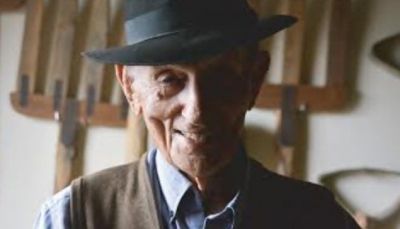
This Thursday, December 10, marks the 101st anniversary of the birth of craftsman Juan Brito, who died in February 2018 at the age of 98, and his son Pedro Brito wanted to pay tribute to his father with a writing, in which he especially remembers him as "a storyteller", who became "the memory of Lanzarote."
"Lanzarote was his reason for being, his memory. One could not be understood without the other," says Pedro Brito, who recalls some moments lived with his father.
101st anniversary of the birth of Juan Brito
"My father was a storyteller. I knew it the day a couple from the peninsula arrived at the ceramics workshop where he worked in Los Cocoteros (Guatiza). That day I accompanied him while he was raising one of his figures from The Mythology of Princess Ico. That couple arrived there because they had been told about a man who knew Lanzarote better than anyone else, and in that meeting an intimate atmosphere was created. At the same time that my father was shaping the figure, he was also doing it with the island, and each gesture with his hand in the clay was accompanied by a memory. Thus, hours later, that couple of visitors knew more about Lanzarote than most of the locals.
When we were already saying goodbye, the woman approached and bent down to say to me in a low and excited voice: Your father is an artist.
I looked at my father as he shook the mud from his hands on the apron he worked with to say goodbye to his guests, and I was filled with pride.
This situation was repeated countless times and in many places: In the living room of my house, in casual encounters while we walked through Arrecife, in presentations of some of his books, or in talks in which he was the guest. In all those moments, what was experienced in the ceramics workshop was recreated. My father was shaping the Island: its volcanic origin, its first inhabitants, the story of The Mythology of Princess Ico and each of its protagonists (Fayna, Zonzamas, Uga, Famara....), the conquest, the pirate attacks, the trade of the orchilla, the names of its mountains, the special way in which the locals developed agriculture, its music and its dance, the tools of the field, the work of the camels and the best camel driver, Don Hilario. Also those trades that took Lanzarote out of its poverty such as the weavers, the harvesters, salt workers, cabuqueros, palm cutters that were then used to make baskets, the potters and their teacher Doña Dorotea, and so many things that he knew.
I knew that my father had become the memory of Lanzarote but I also knew, with the same certainty, that Lanzarote was his reason for being, his memory. One could not be understood without the other. This Thursday, December 10, will be the 101st anniversary of his birth. As I write this, I imagine my father in his ceramics workshop, shaking his hands on his apron to remove the mud and be able to welcome the next visitor who was going to fall in love, irremediably, with Lanzarote."


