
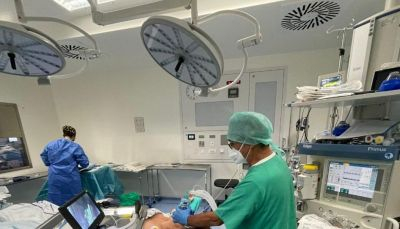
The Anesthesia and Resuscitation service of the Doctor José Molina Orosa University Hospital, a center attached to the Ministry of Health of the Government of the Canary Islands, incorporates a laryngeal mask with integrated vision that allows reducing intubations in surgical interventions and increases the safety of patients requiring anesthesia.
This is a very novel device for airway management, designed by a Spanish doctor, which allows anesthesiologists to see at all times what happens to the patient and guarantees possible intubation if necessary.
Since its incorporation into the service last August, it has been used in eight surgical procedures with very satisfactory results.
The Molina Orosa thus becomes one of the twenty hospitals in Spain and the first in the Canary Islands to opt for this new technology that was presented at the Congress of the Spanish Society of Anesthesiology, Resuscitation and Pain Therapy held in Santiago de Compostela last April.
Pioneering device
The continuous vision laryngeal mask is applicable to patients eligible for general anesthesia in certain surgical interventions and is presented as an alternative to endotracheal intubation and is much less invasive than this.
The main advantage of this pioneering device, according to anesthesia specialists, is that it allows visualizing the patient's anatomical structures at all times, something that was impossible with those available until now and, therefore, results in the safety of the patient and the professional themselves when carrying out the intervention because it facilitates the diagnosis of possible complications.
Likewise, they emphasize and highlight that the mask itself allows intubation of the patient if necessary since it has a channel to slide the endotracheal tube. Reasons why the head of the Anesthesia and Resuscitation section of Molina Orosa, Ariel Guerra, believes that it can be used in a significant percentage of surgical procedures with general anesthesia that are carried out in the hospital center.
This new technique, considered an advance in the field of anesthesia, will be very attractive and practical in the field of emergency medicine and intensive care because, in addition to being an easy-to-use device for specialists, it guarantees uninterrupted ventilation of the patient in dangerous situations such as accidents or in patients with respiratory problems.


