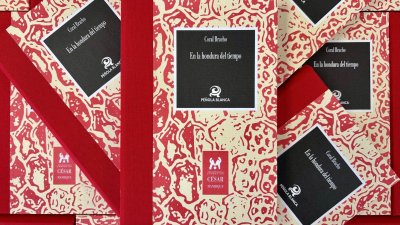
The César Manrique Foundation (FCM) is publishing a new title in its Péñola Blanca poetry collection, which began 30 years ago, in 1995: *En la hondura del tiempo* (In the Depths of Time), by Coral Bracho (Mexico City, 1951). This is the sixteenth installment in this collection of unpublished, bibliophile-style books, whose careful edition was originally designed by Alberto Corazón. *En la hondura del tiempo* brings together 37 poems. The print run is 400 copies, numbered, with the first hundred signed by the author.
In Coral Bracho's words, "poetry is a unique way to open paths to sensitivity and to delve into the dazzling territories of language to approach the world around us, and to influence it." The Mexican author, who received the FIL Award for Literature in Romance Languages 2023 "for her continuous exploration of the politics of poetry and the weight of the written word," states, when discussing the keys to her writing, that "poetic freedom of expression has been and continues to be a necessity for me, but I have always also felt that even the freest poems are subject to rhythmic and sonic demands, even if these are much less perceptible to readers."
In the "Brief Poetics" that accompanies the poems included in her new book, Coral Bracho writes, among other reflections, the following: "When I began to write poetry, free verse and measured verse still coexisted, and more colloquial forms with others more complex that were described as 'neo-baroque' in Latin America. I have always enjoyed reading all kinds of poetry, and I have never felt that any poetic forms are better than others."
Referring to the impact that writing poetry had on her, she specifies: "The incessant interaction of that generative flow and a concentrated analytical and weighing consciousness of new images, and of the sonic, rhythmic, and plastic weight of words, thus coincided in a complex and joyful process of incessant discovery, on different levels of consciousness that poetry writing delves into, and illuminates, in a unique way."
To date, sixteen titles have been published within Péñola Blanca: “Desvío hacia el otro silencio,” by Manuel Padorno (1995); “El vigilante de la nieve,” by Antonio Gamoneda (1995); “Nadie,” by José Ángel Valente (1996); “Poemes-Poemas,” by Joan Brossa (1997); “Tejas: Lugar de Dios. Obertura,” by Francisco Pino (2000); “Órganos dispersos,” by José-Miguel Ullán (2000); “Tantear la noche,” by Juan Gelman (2000); “En las hospitalarias estrofas,” by Carlos Germán Belli (2001); “Nudos,” by Jorge E. Eielson (2002); “Cecilia,” by Antonio Gamoneda (2004); “Cuadernos de apuntes y esbozos poéticos del destemplado Palinuro Atlántico,” by Eugenio Padorno (2005); “Poemas laterales,” by Claudio Rodríguez (2006); “En el centro de un círculo de islas,” by Andrés Sánchez Robayna (2007); “Novísimos aerolitos,” by Carlos Edmundo de Ory (2009); “Entre 2001 y 2006. En el curso de «Y todos estábamos vivos»,” by Olvido García Valdés (2023); and “En la hondura del tiempo,” by Coral Bracho (2025). Coral Bracho has published most of her poetry books with Ediciones Era. She has created an extensive poetic work that is considered one of the most brilliant careers in contemporary Mexican poetry. She was a fellow of the John Simon Guggenheim Foundation in New York and the National System of Art Creators in Mexico. She has been recognized with prestigious international awards: the National Poetry Prize of Aguascalientes (1981), the Xavier Villaurrutia Prize (2003), the Jaime Sabines-Gatien Lapointe International Poetry Prize (2011), the Víctor Sandoval Latin American Poets Prize (2016), and the aforementioned FIL Award for Literature in Romance Languages 2023. Recently, in our country, she received the XXI Federico García Lorca International Poetry Prize City of Granada, 2024. Her poetry is characterized by plastic sensoriality, commitment to life, and the rigor of thought dissolved in everyday breathing. Among her numerous books, notable titles include “El ser que va a morir” (1981), “Huellas de luz” (1994), “La voluntad del ámbar” (1998), “Ese espacio, ese jardín” (2003), “Cuarto de hotel” (2007), and “Debe ser un malentendido” (2018). Translations and anthologies of her work have been published in various countries. The publishing house Pre-Textos, Valencia, has released her “Poesía reunida. 1977-2023” this year.


Add La Voz de Lanzarote as a preferred Google source.
Stay informed with the latest current news.