
The increase in population in Lanzarote, driven by tourists and residents, makes it increasingly urgent to find a solution to water management and waste control without affecting the environment. The island added nearly 60,000 inhabitants in 30 years, from 1993 to 2023, while last year it exceeded four million visitors, including conventional tourists and cruise passengers. Besieged by drought and declared in a water emergency, Lanzarote only reused 6.4% of its water, according to 2023 data. This represents only a 1.6% increase compared to 2001 and three points below its maximum in 2015. This is according to the Informe 4 islas 2024, analyzed by La Voz.
Faced with this situation, Jill Airoldi and Anthony Meye, residents of the municipality of Tías, founded the AguaRenace project, a Canarian initiative that seeks to make Lanzarote a pioneer in greywater recycling and give this fundamental resource a second life. Greywater is that generated in showers, sinks, washing machines, sinks or after cleaning and, unlike blackwater, does not contain human waste.
For now, this water ends up in Lanzarote's canalization systems and ends up in cesspools or the sea. However, medium-sized Spanish cities such as Sabadell, or large cities such as Barcelona already require the recycling of this type of water.
The contradiction of Lanzarote
"In Lanzarote there is a contradiction between towns and municipalities. In some, there is an enormous shortage, where they almost live without water, and in other places, such as Puerto del Carmen, there is an overexploitation of this resource," reveals Jill Airoldi during a conversation with this editorial team. "It shocks me to think that we are using drinking water to flush the toilet, while in other places there are towns that almost live without drinking water," she reflects.
This entrepreneur lived for eight years in the Canadian city of Montreal and returned to the island a year ago. "In Canada, water resources are a little less limited than here, and when I came back to live here, my partner and I saw the need to put solutions into practice," she says during a conversation with La Voz.
Thus, among the proposed systems is Aqualoop, which is capable of treating between 300 and 5,400 liters of water per day, depending on its size. This project argues that it generates a "reduction of environmental impact", while "reduces costs in billing and sanitation" and promotes "self-sufficiency". In addition, it has been applied by the housing cooperative Sostre Civic, in Catalonia, in different projects in the Catalan community.
A chemical-free process
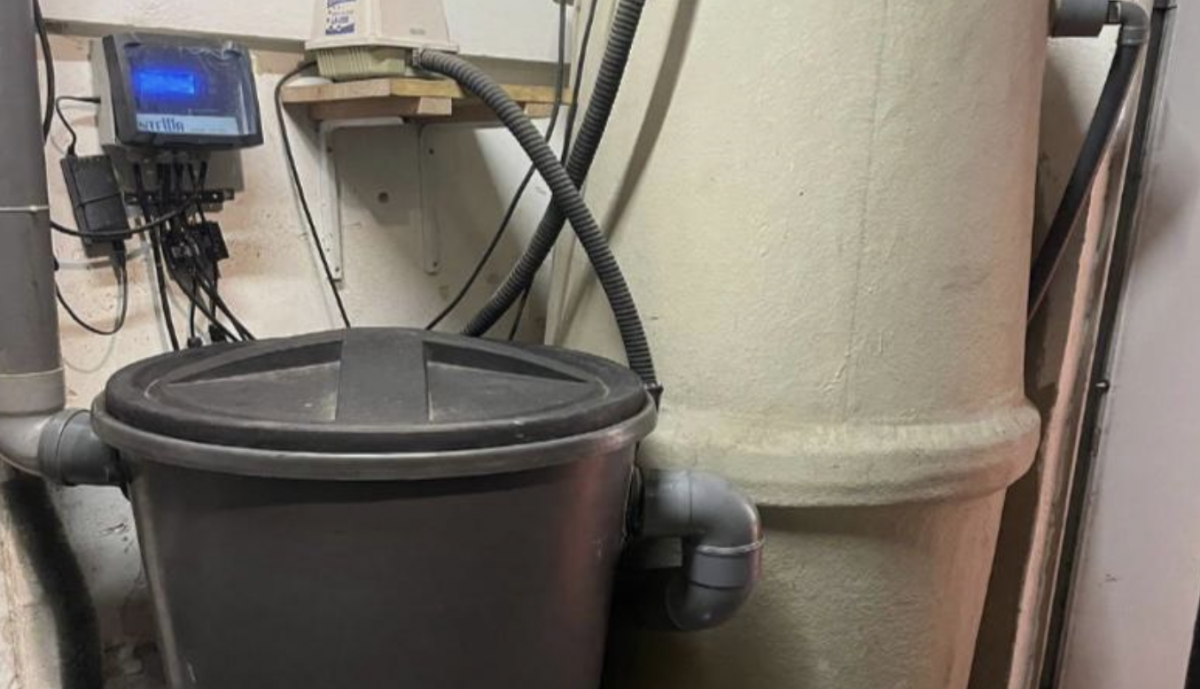
Therefore, the AguaRenace project emerged in September 2024 to respond to this situation in single-family homes, buildings, tourist centers and hotels. "The systems, both the greywater collection and the rainwater collection, are part of a kit that will recycle the amount of liters of water that they need or produce," explains Airoldi.
To achieve this, they use the technology of Intewa, a German company that has been installing these systems for 30 years, and EcoSpai, a Barcelona-based company expert in sustainable construction that has a group of architects to install this system.
This technology, first of all, collects and pre-filters the water. Then, it goes through an aeration system, which moves the organic matter to the surface and filters it; while finally it passes through membranes capable of purifying viruses, bacteria or microorganisms.
"We are not going to add any chemical product and, subsequently, there is a final filtering that eliminates all the particles that may have remained," adds Airoldi. This reused water can then be used to fill the toilet cistern, for cleaning or also for irrigation.
On the other hand, collecting rainwater is easier and they offer a technology that performs a pre-filtering and filtering of organic and residual matter.


Add La Voz de Lanzarote as a preferred Google source.
Stay informed with the latest current news.