
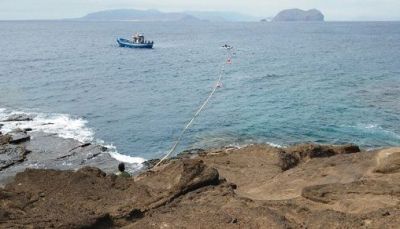
"A task that seemed impossible to many has been achieved thanks to the help of people committed to the conservation of this unique natural space in the Canary Islands." This is how Laura Gangoso, a member of the research team at the Doñana Biological Station, CSIC, summarizes the "titanic" work they undertook a few weeks ago to bring water to the old Alegranza dam, located in a ravine 25 meters high.
The reservoir had completely dried up, leaving the birds that nest in the area, and especially the Eleonor's falcons, which are in full breeding season, without this source of life. "The falcons, like many other birds that inhabit Alegranza and surrounding islets, come to this enclave every day to drink and bathe to get rid of salt abrasion. However, the silting up due to erosion and the drought of the last two years caused it to dry up completely," says Laura Gangoso in an article she has sent to La Voz.
Faced with this situation, "in the middle of reproduction and with the dam dry, the falcons are forced to travel great distances, abandoning their nests in search of the precious resource, with the consequent risk for the success of reproduction." For this reason, she explains that the research team at the Doñana Biological Station decided to act and bring fresh water back to the reservoir.
A "complicated" objective with several obstacles
"The objective was expected to be complicated. The dam is located in a ravine, twenty-five meters above sea level and three hundred meters from the nearest mooring point. A tanker ship, a pump capable of pumping the water and many meters of hose were needed," explains Laura Gangoso.
Fortunately, she celebrates that they were able to count "on the selfless help and collaboration of people and private and particular entities on the island of La Graciosa to obtain the necessary material, as well as the owners of Alegranza, who joined this titanic maneuver."
On August 5, the Sol y Playa boat set sail loaded with 8,000 liters of drinking water. "With great effort, we managed to deploy the hoses, raise them to the dam and activate the pump. Unfortunately, the pressure exerted was not enough and after hours of frustrated attempts, we had to give up and the boat returned to La Graciosa still with its cargo intact," she recalls.
However, they did not give up. At that moment they decided to ask for help from the president of the Cabildo, Pedro San Ginés, who in turn contacted Canal Gestión Lanzarote, who provided them with a suitable pump. "Six days later, taking advantage of a break in the wind and sea storm, the precious liquid was returned to its destination," and this time successfully.
We will have to "repeat the operation"
Although the research team at the Doñana Biological Station explains that 8,000 liters of water may seem like "a large amount", they clarify that the water level in the dam only rose "a few centimeters and the contribution will not last long, due to evaporation." For this reason, they will try to "repeat the operation" shortly.
But for the moment, they have already covered the first objective, providing water "for several weeks" to these birds, in a key period. Eleonor's falcons return to the Canary Islands every year, specifically to the Chinijo archipelago, to reproduce, and they do so precisely on these dates, between the months of August and September.
That is why the research team at the Doñana Biological Station considered it so important that they had access to fresh water, and undertook this complicated mission. In her writing, one of the members of this team wanted to thank all those who have collaborated to make it possible, including the people of La Graciosa; the media coordinator of the marine reserve, Jorge Cáceres; the president of the Cabildo, Pedro San Ginés, the CEO of La Graciosa, Alicia Páez; and Canal Gestión Lanzarote.


