
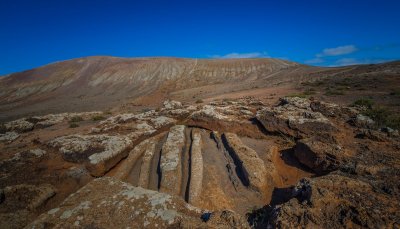
The orography of the islands completely conditioned the diet of the Canarian aborigines, who were forced to adapt to the environment and seek food that was more readily available. This is the conclusion reached by five researchers from the universities of Las Palmas de Gran Canaria and Burgos in a study published in the scientific journal Scientific reports.
Specifically, this research has analyzed the period between the 1st and 15th centuries AD. To do this, they have taken samples of bone collagen from 457 human remains collected from archaeological sites on the seven islands.
In the case of Lanzarote, due to its desert landscape and low altitude, the results have revealed that the Majos based their diet especially on marine foods, "probably complicated by the aridity and the effects of marine aerosols." Thanks to this, the ancient inhabitants were able to supplement their diet with fish and seafood with the little they could cultivate in land as arid as Lanzarote's.
In fact, the researchers have discovered that on all islands, except for Lanzarote and Fuerteventura, crops "were the predominant source of food." However, this was not the case on the easternmost islands, as they have identified "a greater dependence on marine resources."
Regarding Lanzarote and Fuerteventura, the analyzed remains reveal that the Majos also consumed animals with high trophic content, that is, animals that preyed on others, such as seabirds and marine mammals (seals, for example).
Furthermore, the analyzed data show that on these desert islands, between the years 1,300 and 1499 AD, there was a possible change in "dietary practices or ecological conditions during this period."
However, this changes on the rest of the islands in the archipelago that exceed 1,500 meters in altitude. In their case, having more vegetation, humidity, and better fertility, they had a diet based on crops of different cereals such as barley or wheat and, at the same time, on goat and sheep farming.
Add La Voz de Lanzarote as a preferred Google source.
Stay informed with the latest current news.


