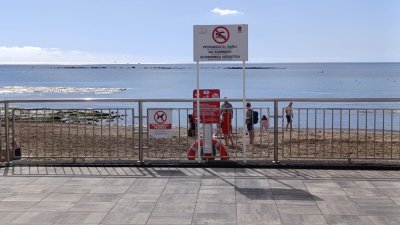
The capital of Lanzarote and the tourist centers concentrate the majority of wastewater discharges from land to the sea, even affecting the most popular beaches of Lanzarote. This is clear from the analysis of the updated census in the Territorial Information System of the Canary Islands to which La Voz has had access. Of these, Arrecife concentrates almost five out of every ten spills that occur on the island, being the most affected municipality.
Throughout the past year, its most famous beach, El Reducto, had to be closed to swimming on several occasions due to wastewater spills. In addition, the Charco de San Ginés has been at the center of controversy in recent years due to the appearance of wipes on its bottom and the bad smell of its water.
Las Caletas and Puerto Naos
In the Las Caletas power plant, already located in the municipality of Arrecife, there are three active points and another three registered, but which have no activity. The Unión Eléctrica de Canarias Generación SAU, owned by Endesa, legally discharges cooling water, oily water treated regularly, and cooling water at a second point into the sea.
In this same space, at Punta de Los Vientos, Canal Gestión Lanzarote manages a discharge point, owned by the Insular Water Consortium, which discharges brine from three desalination plants onto the coastline. The other three points in the place are not active.
Two kilometers from the Punta Grande power plant, there is a fourth active discharge point, which discharges urban wastewater treated at the Agramar Wastewater Pumping Station in Puerto Naos in situations of excess and emergency. This point, managed by Canal Gestión Lanzarote and owned by the Water Consortium, remains active but does not have authorization. This unauthorized discharge occurs near a bathing area, La Arena beach, and close to the coastline.
It should be noted that, as in this case, all the facilities managed by the subsidiary of Canal Isabel II de Madrid in Lanzarote are owned by the Consortium.
In the same area, there is a regular discharge of industrial wastewater from aquaculture tanks, owned by the Polytechnic Institute of Maritime Fishing Professional Training of the Canary Islands and managed by the Vice-Ministry of Fisheries. This discharge is authorized and occurs on the port.
Three discharge points in San Ginés
In less than 300 meters in a straight line, the Charco de San Ginés has three unauthorized wastewater discharge points. Owned by the Insular Water Consortium and managed by Canal Gestión, the company in charge of the island's integral water cycle assures that the Consortium is responsible for keeping these authorizations up to date.
The first of these three points is installed on the public maritime-terrestrial domain and discharges urban wastewater from the Puntilla pumping station in situations of excess or emergency. In the same space, the surplus urban wastewater from the Barquillo and Alcorde wastewater pumping stations is also discharged into the sea.
The Arrecife City Council demanded that the Lanzarote Water Consortium and Canal Gestión Lanzarote urgently regularize the points detected in the aforementioned report.
The Casino and El Reducto
A little more than half a kilometer from the Charco de San Ginés, urban wastewater from the sewage network is also discharged into the sea at a pumping station located next to the Casino-Real Nautical Club of Arrecife. This point, owned by the Consortium and, therefore, managed by Canal Gestión, discharges into the sea without authorization in situations of network saturation. This area is a common bathing area in the city and water sports and tournaments are also practiced there.
The most popular beach in Arrecife, El Reducto, has two unauthorized discharge points very close by that discharge the surplus wastewater from two wastewater pumping stations, Portugal and Las Buganvillas, and also that from the sewage network into the sea in emergency situations. Located in Punta del Camello, this point serves as a relief valve and is managed by Canal Gestión.
El Cable and La Concha
The last discharge points registered in the capital of Lanzarote also do not have authorization. The first occurs on pebbles and rocks on El Cable beach, while the second does so on the upper part of La Concha beach, under the promenade.
Both in the hands of Canal Gestión, these unauthorized pipes discharge wastewater from the sewage network in this area into the sea in situations of emergency and excess.
To which is added the aggravating factor that in the case of La Concha beach, attached to Playa Honda, the discharge affects a zone of special conservation, that of the Sebadales de Guasimeta and the beach itself.


Add La Voz de Lanzarote as a preferred Google source.
Stay informed with the latest current news.