
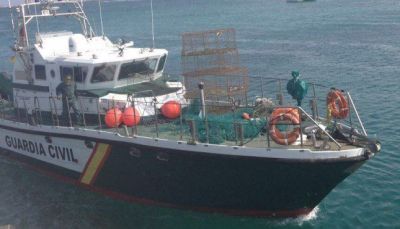
The Civil Guard has seized this weekend four fish traps located both on the edge of the Chinijo Archipelago Reserve and in the northwest area of Lanzarote. All four were not properly marked, thus failing to comply with current regulations. In addition, three trammel nets were located near La Santa, a form of fishing "totally" prohibited because it is not selective in "terms of quantity, size and species".
The first location was made by the Civil Guard on the edge of the Chinijo Archipelago Reserve, where they lifted two fish traps that were unmarked and baited, thus failing to comply with regulations on their use. "Inside were different species of fish, alive, which were returned to the sea," the Civil Guard has reported. The second location was made in the northwest area of the island, where the Civil Guard located "again two other fish traps without proper marking".
On the other hand, the Maritime Detachment of Fuerteventura located "three trammel nets less than one mile away from the town of La Santa (Lanzarote)". They emphasize that it is a "fishing gear totally prohibited in these waters due to its non-selective potential for catches in terms of quantity, size and species." In them, the Detachment found "trapped a large number of "viejas", as this emblematic fish of the Canary Archipelago is known, most of which did not meet the minimum allowed size," they pointed out.
The furtive use of fish traps can be sanctioned with 60,000 euros
On the other hand, the Civil Guard found two longlines adrift near the island of Lobos, totaling about 3,000 meters in length between the two. These "represent a danger to boats, birds, marine fauna and bathers or practitioners of water sports," the Civil Guard explained.
According to the Civil Guard, "the furtive use of fish traps on the maritime coast can lead to administrative sanctions of up to 60,000 euros, under Title V of Law 3/2001, of March 26, on Maritime Fisheries of the State".
All the seized gear "has been made available to the Vice-Ministry of Fisheries and Agriculture of the Government of the Canary Islands for subsequent destruction, with the Civil Guard continuing with the operation against illegal fish traps," according to the statement.
Currently, the use of fish traps is regulated in the aforementioned Order -specifically articles 12 and 13- and in Royal Decree 182/2004, of December 21 -article 25- which develops the Regulations of the Fisheries Law of the Canary Islands; these legal norms establish a series of provisions such as the regulation of the identification plates of the fish traps and the minimum depth at which they must be located, as well as the marking of the same and allowed buoys.
The Civil Guard assures that "citizen collaboration has been fundamental in the finding of the longlines adrift, being fishermen of the area who communicated the possible existence of said gear". For this reason, it has an email address, [email protected] , whose purpose is the general attention to the citizen, serving also as a channel to receive information on matters that may initiate an investigation.


