
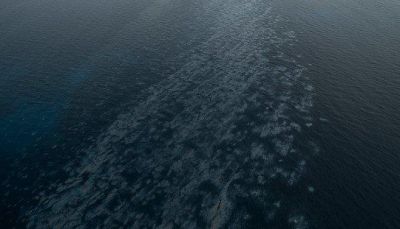
From the early hours of this Sunday morning, a Greenpeace team has accompanied the Canary Islands Government helicopter to document the situation of the spill caused by the sinking of the illegal fishing vessel Oleg Naydenov. The organization has flown to the point of the sinking, where it has been able to verify the presence of a dense stain between 4 and 5 kilometers long that continues to extend south.
"Greenpeace has confirmed today that there is a significant stain in the sinking area, which indicates that the fishing vessel is still leaking fuel. It is crucial to put more resources into cleaning up this stain and proceed with the immediate extraction of the fuel remaining in the tanks." said Luis Ferreirim, Greenpeace spokesperson from El Berriel aerodrome. "If the spill is not stopped and all the fuel is extracted, it is only a matter of time before deep underwater currents can throw the spill back to the coast and the damage will be even greater," Ferreirim concluded.
Although no significant arrival of more fuel to the coasts of Gran Canaria has been reported again, it continues to come out of the tanks of the sunken ship at 2,700 meters. Therefore, the large pollution stain continues to increase in the ocean. The stain extends from 15 miles, off the coast of Maspalomas, with the first stain already about 200 miles from the coast, as reported today by the Ministry of Development. The fuel that continues to emanate from the Oleg Naydenov fishing vessel could be transported again by deep currents towards the coasts, as Greenpeace documented on April 23, causing significant damage to the coastal ecosystem.
Therefore, it is "crucial to plug the leaks as soon as possible, extract the remaining fuel from the tanks and put more resources into control and cleaning also on this front of the spill further away from the coast", they indicate from the institution. "In this reconnaissance flight, Greenpeace has also been able to verify that in front of the coast at this moment there are still small, very dispersed trails of fuel. This Saturday, a team from the organization was able to corroborate in a maritime reconnaissance along the coast that between Puerto de Mogán and Cabo Descojonado the cliffs were much better than could be expected, but that it is important to act urgently to stop the spill and preserve an area of such high value," they point out.
Greenpeace also asks that the "Ministry of Development and the Government of the Canary Islands proactively integrate the island's social groups and entities into the coordination and monitoring tasks of the spill, since they are the ones who best know the terrain and suffer the impacts of the spills firsthand".


