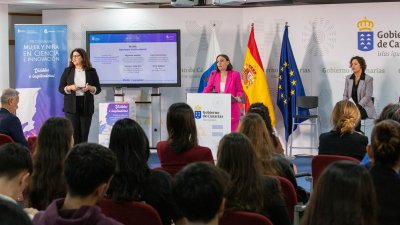
The Ministry of Universities, Science and Innovation and Culture of the Government of the Canary Islands, headed by Migdalia Machín, presented the second edition of the MUCICA Study (Woman and Science in the Canary Islands) this Wednesday on the occasion of the International Day of Women and Girls in Science.
This meeting, which is part of the Program Woman and Girl in Science and Innovation promoted by ACIISI, had the support of the DISA Foundation, the collaboration of the Canary public universities and different agents of the scientific and technological system.
During the institutional opening, Machín emphasized that “science does not only live in laboratories, it is in the sea that surrounds us, in the volcanoes that remind us of where we come from, in the sky of our nights, in the stars we look at from the islands. It is also in the technology we use every day and in the questions we ask ourselves when something doesn’t fit.”
The counselor added that “Canary Islands needs female scientists, engineers, researchers, mathematicians, and technologists; and it needs them because the future is built with knowledge, innovation, and opportunities”. This study not only provides data but a necessary roadmap for the social cohesion of the islands, she pointed out.
In her speech, the counselor highlighted that, although the data show a Canary youth with notable ambition, where more than 89% wish to continue higher education, there is a critical disconnect in technical areas.
“Young women continue to be underrepresented in engineering and technology not due to a lack of ability, but due to the persistence of cultural barriers and gender stereotypes,” stated Machín, who placed special emphasis on the fact that more than 90% of Canary Islands students declare they do not know of female role models in science in their own environment, and “without role models it is more difficult to imagine oneself as a protagonist.”
Woman and Science in the Canary Islands (MUCICA II) is not a destination but an impetus, “only through collaboration and co-responsibility will we be able to take full advantage of it,” the counselor pointed out. From CUCIC, we are committed to strengthening vocational guidance from an early age, to continuing to promote scientific dissemination with a gender perspective, to making Canary Islands female talent visible, and to reducing the territorial inequalities that still persist in access to higher education, she said.
Also participating in the opening ceremony were Lara Carrascosa Puertas, deputy director of the University Institute for Women of the ULL, and Carmen Delia Díaz Bolaños, director of Equality of the ULPGC.
Convert youthful ambition into scientific vocation
The MUCICA II document confirms that Canarian youth show a high interest in continuing higher education (89.2%), but vocations in STEM areas remain minority (around 22–23%) and present a persistent gender gap: only 12.9% of female students express interest in these disciplines compared to 29% of male students.
The investigation, based on a sample of more than 1,300 students from the eight islands and completed with the vision of university faculty and students, identifies structural and symbolic factors as the main barriers, such as lack of guidance, economic limitations, insularity, and scarce knowledge of female role models in science and technology —more than 90% of students do not know Canary Islands female scientists—.
The report also underlines that the island of origin significantly conditions educational trajectories and that the first university courses are critical for consolidating or losing scientific vocations, especially in the case of women.
The educational dimension was reinforced through a live connection with the initiative “Nosotras Hacemos Ciencia 2026”, in which 4,100 Secondary, Baccalaureate, and Vocational Training students from 70 educational centers throughout the Canary Islands participate, the true target audience of policies to promote scientific vocations.
These outreach talks, given by leading female scientists in different fields of science and research, make visible the role of women in this area and foster interest in scientific and technological fields among young Canary Islanders, also strengthening an essential mentoring network to boost STEM vocations in the Archipelago.
From data to experience: Canarian researchers define the keys to change
After the presentation of the Study, the day moved on to a debate panel that focused on the challenges and opportunities of science and innovation in the Canary Islands from a gender perspective. Researchers, managers, and institutional leaders shared experiences, career paths, and proposals, emphasizing the importance of having visible role models, solid training pathways, and inclusive professional environments.
Guayarmina Peña García, executive CEO of the Canary Islands Technological Institute (ITC); Sara González Pérez, researcher at the University of La Laguna; Raibel Núñez González, researcher at the University of Las Palmas de Gran Canaria and STEAM Facilitator of the Margarita Salas Foundation; and Adriana Lorenzo-Cáceres Rodríguez, researcher at the University of La Laguna and the Canary Islands Institute of Astrophysics participated in it.
The debate allowed the data from the Report to be grounded in concrete realities, connecting the research with the everyday experience of women who develop their careers in the scientific-technological field. The role of collaboration between administrations, universities, research centers, and private entities as a way to consolidate real and sustainable progress was also highlighted.

Add La Voz de Lanzarote as a preferred Google source.
Stay informed with the latest current news.