
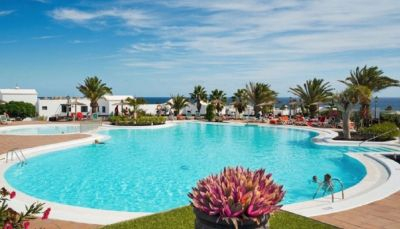
Since this December, the Costa Sal Suites in Puerto del Carmen in Lanzarote has become the first ONCE hotel in the archipelago. It belongs to Ilunion, the group of companies of the national organization of the blind, which seeks to diversify its sources of income and facilitate the labor integration of its members.
Ilunion has more than 50 lines of business, which include physiotherapy clinics, day centers, cleaning services, laundry, stores and a total of 30 hotels, since the incorporation of the Lanzarote establishment.
Ekonomus has talked about the acquisition of this 4-star hotel, which has 162 apartments, villas and bungalows, with José Antonio López Mármol, territorial delegate of ONCE in the Canary Islands.

Could you give us more details about the first ONCE hotel in the Canary Islands?
It is the Costa Sal Suites in Puerto del Carmen, a very well preserved hotel, which had been recently renovated. It has a plot of 33,000 square meters and is of medium capacity. It is a 4 star hotel, built in the typical Lanzarote style, in extension and not in height. It is very pleasant to walk through its spaces, its gardens.
Who can go to the ONCE hotels? Are they only for members?
The hotels are freely accessible and anyone can go. Normally people with disabilities usually feel very comfortable in them, because all the staff is trained to assist people with disabilities. But all kinds of people come to the hotels we have, both in the city and on vacation.
We have a discount for members, although the hotels are not made for people with disabilities to have any extraordinary priority, but to generate employment and be profitable.
How do ONCE companies generate employment and profitability?
The ONCE group of social enterprises aims to grow economically to continue generating employment and social wealth, unlike ONCE itself, which is a public law corporation and non-profit.
It is true that companies considered employment centers, being of social initiative, reinvest all the money they earn to continue growing and create more special employment centers, as is the case with ONCE laundries, the most important chain we have in Spain and that continues to grow.
In fact, the health crisis stopped us from the idea of creating a laundry in Lanzarote. Although the purchase of the hotel has now been prioritized, we do not rule out having other types of companies that continue to generate employment in Lanzarote in the future.
Are you going to carry out reforms in the hotel to improve accessibility? What are ONCE hotels like in this sense?
I think the hotel already has 6 adapted rooms, but some work will have to be done to remove barriers.
ONCE hotels have around 10% of adapted rooms, in line with the percentage of people who need it. Not everyone goes in a wheelchair or uses a cane. We must attend to the different disabilities as best as possible.
In some way they are hotels that think about people, there is diversity among their employees, which include people with and without disabilities. We try to make customer service excellent. Most of the hotels are four stars, some five stars as well.
How many workers does the Lanzarote hotel have? Are you going to hire people with disabilities?
The hotel has around 55 workers. When ONCE acquires a hotel, it usually keeps all the employees, although the ultimate goal is to hire as many people with disabilities as possible, but this is carried out in the medium and long term, as places become available.
Is your goal that all workers are ONCE members?
All is very difficult, in Lanzarote it is not easy to find people with disabilities who have the profiles or training to work in a hotel. But as an example, of the 30 hotels that the chain has, 14 are employment centers, which means that they have 70% of people with disabilities working.
Do you have any message for the people of Lanzarote?
I would like to thank the society of Lanzarote for the support they always give to our colleagues, to the ONCE vendors, which in the end is where everything starts, so that the organization can invest and continue generating employment and social wealth.


