Restoring Lanzarote's architectural heritage is not an easy task. The architect specialized in this type of buildings Patricia Betancort already explained in Ekonomus some of the main difficulties.
“The acquisition of Villa Mora has been quite an odyssey, the file to buy it has been there since 2013”, said the mayor of Haría, Alfredo Villalba, during a recent interview on Radio Lanzarote-Onda Cero.
The property, which consists of 8,000 square meters and is considered by the Historical Heritage Unit of the Cabildo as a building of great interest, has been acquired by the northern City Council for one million euros.
All together to recover the heritage of Lanzarote
Currently, it seems that all sectors are aligning to recover the architectural heritage of the island.
To begin with, Lanzarote society is increasingly aware of the importance of protecting the history of Lanzarote as an intrinsic part of the island's identity, which is reflected in the boost that public administrations are giving to this issue.
And to continue, heritage is also increasingly relevant for travelers visiting Lanzarote, which is noticeable, and a lot, in the private initiative, which is recovering emblematic buildings throughout the island to create unique hotels and restaurants with personality.
The new impulse from the public has been reflected in the case of Villa Mora. “The owner was clear that he wanted the Villa to pass into public ownership and remain with the people of Haría”, confirmed the mayor. According to La Voz, the former owner had rejected private foreign offers for at least twice the amount paid by the City Council.
An administration that has been determined in recent times to move this file forward and that plans to continue along this line: “It will not be the only one”, said Villalba, “we intend to continue strengthening the core of Haría, especially the inland towns that need to establish population and maintain their idiosyncrasy and their history”.
And if there is a town, with the permission of La Villa de Teguise, in which one feels transported to different eras of the history of this island, and of the people who inhabited it, that is Haría.
A property with presence
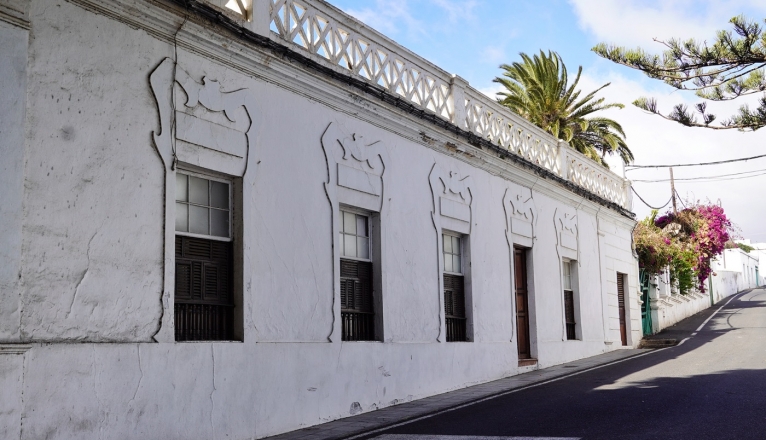
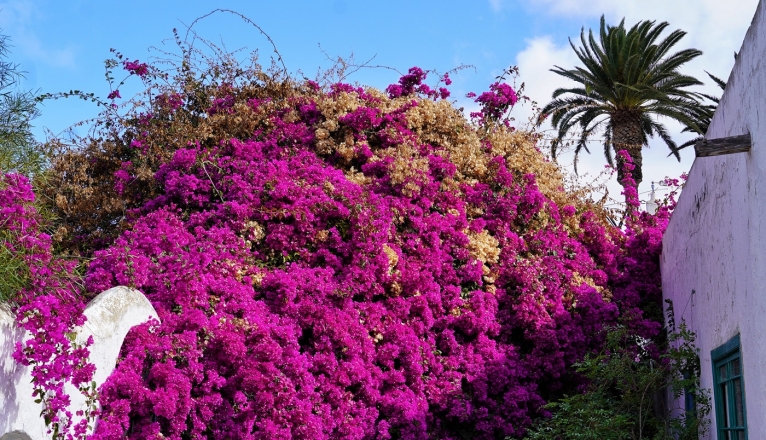
Villa Mora is distributed in 25 rooms, two bathrooms, two garages, three cisterns, patios, rooms for service personnel and large garden areas with Canary Island palm trees and other plant species. Its exterior has decorative elements in the modernist style.
The building belongs to the so-called cultured architecture and its original construction could date from the 18th century, although most of it was built in the 19th century. Its distribution obeys the construction rules of a property of presence, with an entrance hall, and old hydraulic tiles of colors.
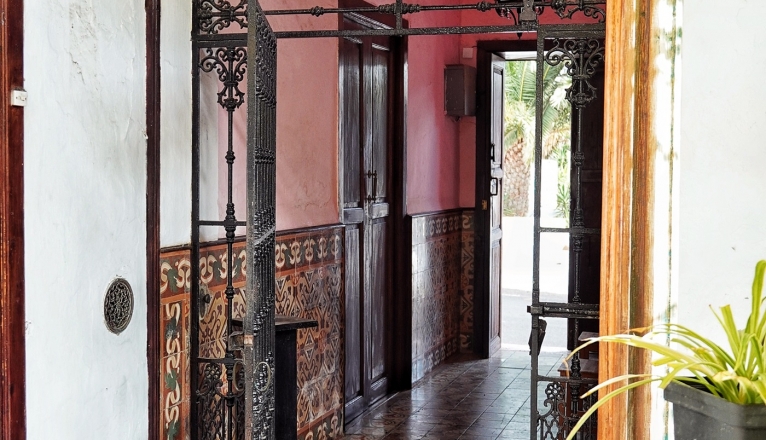
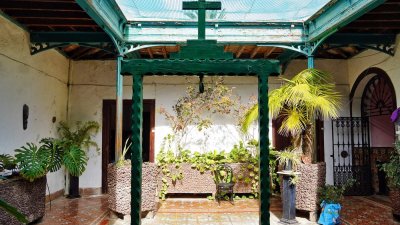
A beautiful iron door crowned in the shape of a semicircular arch gives access to the patio, which has a covered gallery that surrounds it supported by columns. The decorative curvilinear finishes of the corner angles are also preserved.
Many antique furniture from the Victorian era have also been preserved. Several oriental-style pieces decorate the living room and the cabinets retain the original wallpaper inside and a pantry with utensils from the early 20th century.
Villa Mora and the visit of Alfonso XIII
To get an idea of its age, the villa had already been restored five years before the visit of Alfonso XIII in 1906 to the islands, shortly after Spain lost Cuba, Puerto Rico and the Philippines.
There is an oral tradition, inherited from generation to generation, which says that Alfonso XIII was in Haría during that visit and that he was invited to Villa Mora.
If it happened, the press of the time consulted by this newspaper did not reflect it. The correspondent in Lanzarote of the newspaper of that time, El Tiempo de Tenerife, in its edition of April 5, 1906, says that the island of the Volcanoes was the last one visited by the monarch, since from here he was returning to the peninsula.
“Rooms have been prepared for him in the Casino (of Arrecife). The City Council will offer a lunch, for which the owner Don José Pereyra de Armas has provided rich tableware, who has also made his car available to the Mayor to be used by the King”, explained the correspondent shortly before the arrival of the monarch, which gives a good idea of how things worked on the island at that time.
Although some things have not changed so much since that time of splendor in Villa Mora. In its editorial of that day when Alfonso XIII was in Lanzarote, the same newspaper complains that transporting a piano from Barcelona to the Canary Islands "costs 20 duros, while from Liverpool it costs 20 pesetas".
Add La Voz de Lanzarote as a preferred Google source.
Stay informed with the latest current news.